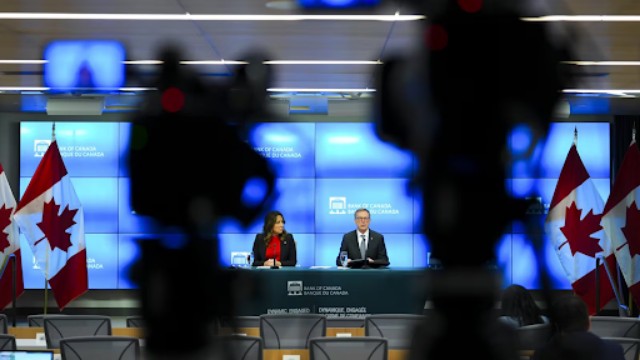
Bank of Canada Governor Tiff Macklem and Senior Deputy Governor Carolyn Rogers speak to reporters during a press conference at the Bank’s Ottawa headquarters on Wednesday, March 12, 2025. (Photo: Sean Kilpatrick / The Canadian Press)
Confidence among Canadian businesses and consumers has taken a noticeable dip as worries surrounding U.S. tariffs and trade tensions grow stronger. According to two new reports from the Bank of Canada, economic uncertainty is making both companies and individuals more cautious about their financial choices.
One report, based on the central bank’s business outlook survey, revealed that nearly one-third of Canadian firms—about 32%—now expect a recession in the country within the next year. That’s more than double the 15% who thought the same just two quarters ago.
This shift in sentiment appears to be directly tied to rising concerns about the broader economic environment. Unstable financial markets, unclear political direction, and ongoing trade challenges—particularly with the United States—are leaving businesses unsure about the future.
This hesitation is visible in several ways. Fewer businesses are planning to boost sales or invest in equipment. Only 43% believe their sales will grow over the next 12 months, a noticeable drop from 53% in late 2024. Similarly, just 31% said they plan to increase spending on machinery and equipment—down from 48% in the previous quarter.
Hiring plans have also slowed. In the latest survey, 32% of businesses expected to grow their workforce in the coming year, a drop from 45% in the final quarter of 2024. Many companies are simply waiting for things to settle before making major decisions.
Another concern highlighted in the report is rising costs. Businesses said they no longer expect prices for their inputs—such as materials or supplies—to ease anytime soon. In fact, two-thirds of those surveyed believe that if widespread tariffs are introduced, their costs will go up significantly. In response, many said they would likely raise their own prices, putting more pressure on consumers.
Inflation expectations are also climbing. Companies now believe that the cost increases from tariffs will outweigh the benefits of weaker demand, driving prices up in the near term.
On the consumer side, there are signs of growing unease as well. The Canadian survey of consumer expectations found that more people are worried about job security—especially those in industries that rely heavily on trade with the U.S.
For the first time since early 2024, more consumers said they are either cutting back or planning to cut back on spending. That shift suggests a tightening of household budgets as uncertainty looms.
Both surveys were conducted before the latest U.S. policy announcement, where President Donald Trump signaled a move toward so-called “reciprocal tariffs,” a statement that rattled markets and fueled fresh fears of a global recession.
The business outlook survey took place from February 6 to 26, while the consumer survey was conducted from January 29 to February 19, with follow-up calls through February 25.
The Bank of Canada, which reduced its key interest rate to 2.75% last month, is expected to release its next policy update on April 16. That rate cut may not have happened if not for the mounting uncertainties from south of the border, the bank said in its last meeting summary.