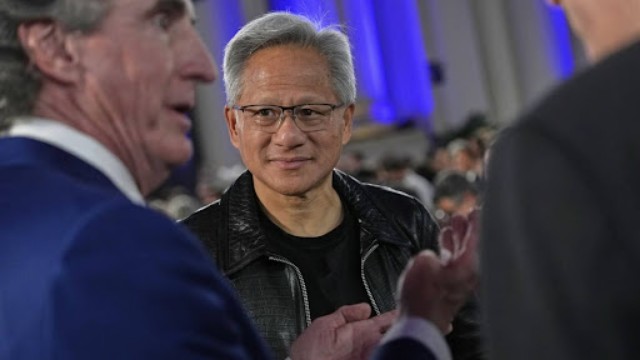
Nvidia CEO Jensen Huang chats with Interior Secretary Doug Burgum ahead of President Donald Trump's address at an AI summit held at the Andrew W. Mellon Auditorium in Washington. (AP Photo/Julia Demaree Nikhinson)
Beijing’s cyberspace watchdog recently summoned Nvidia to discuss concerns over its H20 chips, which China claims might carry “backdoor” features allowing them to be tracked or turned off remotely. The Cyberspace Administration of China shared the update on its official website, stating that the U.S.-based chipmaker must provide a clear explanation and supporting documents about the alleged security risks.
Chinese authorities emphasized the importance of data security for local users and cited concerns from unnamed American AI experts who believe Nvidia's chips have advanced features that could monitor, locate, or even disable them remotely. According to Beijing, these functions pose a significant threat to China’s cybersecurity.
In response, Nvidia pushed back firmly. A company spokesperson told the Associated Press, “Cybersecurity is critically important to us. Nvidia does not have ‘backdoors’ in our chips that would give anyone a remote way to access or control them.” Despite the firm denial, the scrutiny could impact the company’s operations in China, especially its future sales plans.
The timing of the investigation is notable. Just weeks earlier, the U.S. government under former President Trump had lifted a restriction on Nvidia’s H20 chips, allowing the company to reintroduce them to the Chinese market. Nvidia CEO Jensen Huang had announced the return with high enthusiasm during his recent visit to Beijing.
However, this latest development highlights the ongoing tech standoff between the U.S. and China. Both countries are racing to dominate artificial intelligence, and every move regarding chip exports is heavily watched. The situation puts tech companies like Nvidia in the crossfire of geopolitics and trade strategy.
The Chinese regulators’ concerns stem partly from recent U.S. legislative efforts. In May, U.S. Representatives Bill Huizenga and Bill Foster introduced the Chip Security Act, which proposes that high-end chips should include built-in tracking and anti-smuggling tools. Although the bill hasn’t advanced in Congress, it reflects growing bipartisan concern in Washington over AI technology falling into rival hands.
Foster, who has a background in physics, said at the time, “We have the tools to stop powerful AI from ending up in the wrong hands.” While the H20 isn’t Nvidia’s most powerful chip—like its H100 model—it still offers China an advantage, as U.S. lawmakers argue it surpasses China’s homegrown chip capabilities.
Many in Washington were alarmed when the sales restriction was eased. Just days after the change, top Democrats—including Senate Minority Leader Chuck Schumer—sent a letter to Commerce Secretary Howard Lutnick, voicing serious concerns. They believe chips like the H20 could help China train powerful AI systems, and they questioned whether easing restrictions was wise.
Similarly, Republican Congressman John Moolenaar, chair of the House Select Committee on China, criticized the decision. He urged the Commerce Department to stand firm, writing, “We can’t let the CCP use American chips to train AI models that power its military, censor citizens, or challenge U.S. tech leadership.”
As both governments tighten rules around sensitive technology, Nvidia finds itself in a tricky position—balancing compliance with U.S. law while navigating China’s regulatory climate and growing suspicion.