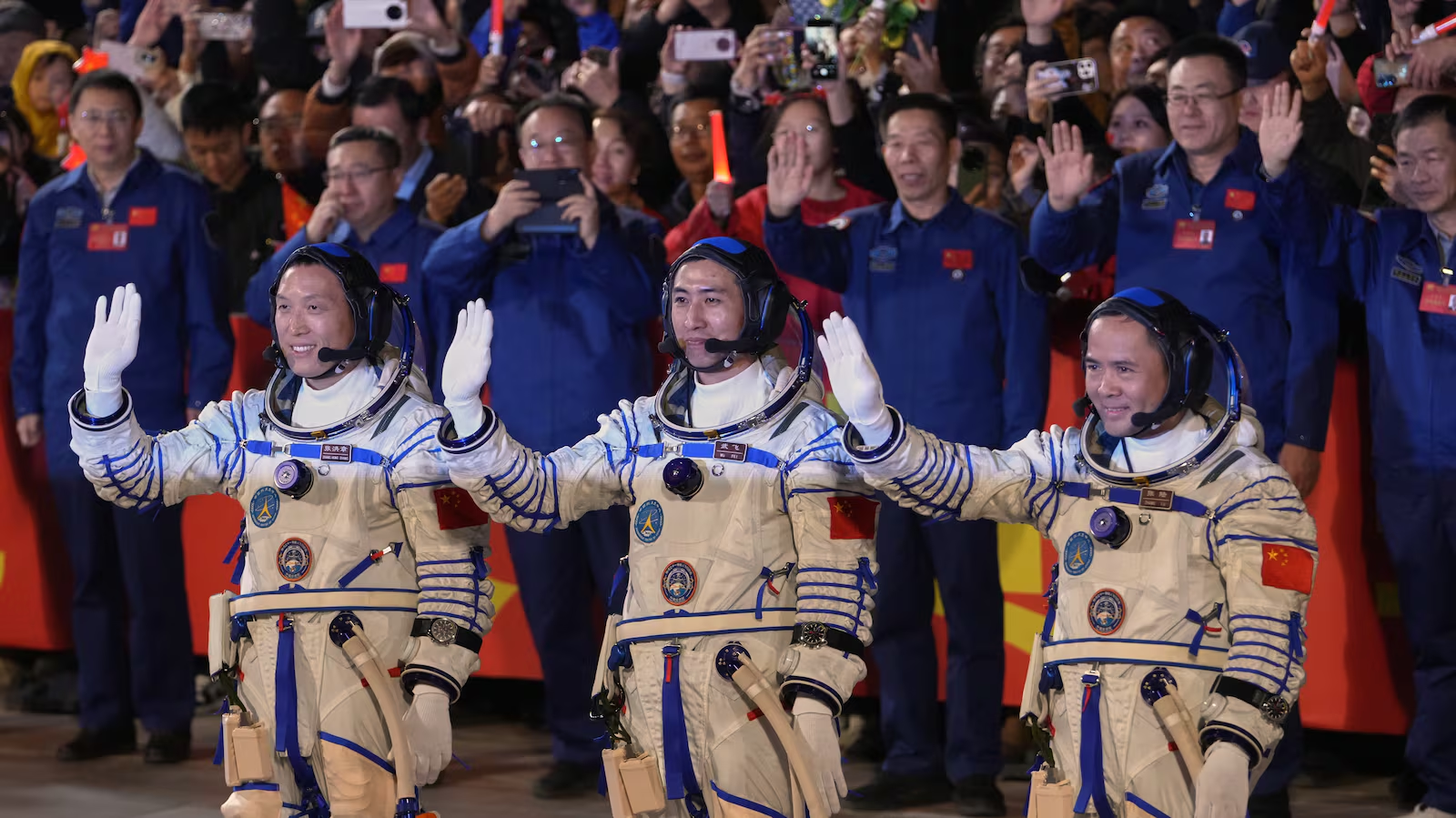
Chinese astronaut for the Shenzhou 21 mission, from left, Zhang Hongzhang, Wu Fei and Zhang Lu wave as they attend a see-off ceremony for their manned space mission at the Jiuquan Satellite Launch Centre in northwestern China, Friday, Oct. 31, 2025. (AP Photo)
China’s latest manned space mission has achieved a new milestone, setting a record for the fastest spacecraft docking in the country’s space history. The Shenzhou 21 spacecraft successfully docked with the Tiangong space station just 3.5 hours after launch — three hours faster than any previous mission.
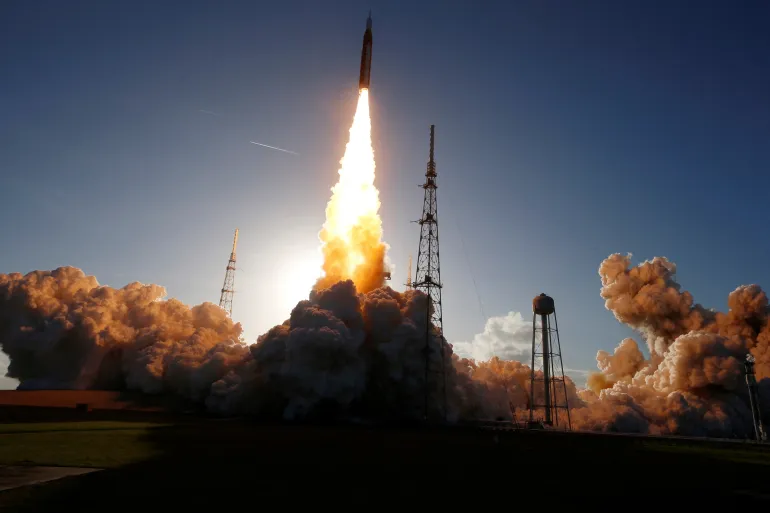
The spacecraft lifted off from the Jiuquan Satellite Launch Centre in northwestern China at 11:44 p.m. local time on Friday. A few hours later, the crew of three astronauts entered the Tianhe core module, marking the start of their six-month stay aboard the orbital station.
The Shenzhou 21 Crew
The mission is commanded by veteran astronaut Zhang Lu, who previously flew aboard Shenzhou 15 in 2023. Joining him are two first-time astronauts — Wu Fei, a 32-year-old engineer and China’s youngest astronaut to travel to space, and Zhang Hongzhang, a payload specialist with a research background in new energy and materials science.
Zhang Lu described the team’s mission as both scientific and spiritual, saying they aim to turn the Tiangong station into a “utopia” by practicing tai chi, gardening, and even reading poetry in space.
Science and Innovation Beyond Earth
While in orbit, the crew will conduct 27 scientific and applied research projects covering biotechnology, materials science, and aerospace medicine. Among the mission’s highlights is China’s first-ever experiment involving live mice in space.
Four specially trained mice — two males and two females — have been sent to study how weightlessness and isolation affect small mammals. Han Pei, an engineer at the Chinese Academy of Sciences, said the experiment aims to “master key technologies for breeding and monitoring small mammals in space” and to evaluate their adaptive behavior in microgravity.
The mice were chosen from 300 candidates after 60 days of rigorous training. They will spend five to seven days aboard Tiangong before returning to Earth on the Shenzhou 20 spacecraft.
Strengthening China’s Space Legacy
The success of Shenzhou 21 reinforces China’s growing role as a global space power. Since launching its first crewed mission in 2003, China has become only the third nation, after the United States and the former Soviet Union, capable of independently sending humans into space.
China’s space program, managed by the People’s Liberation Army, is viewed as a symbol of national pride and technological achievement. The Tiangong station, or “Heavenly Palace,” was designed and built entirely by China after being excluded from the International Space Station program due to U.S. security restrictions.
Eyes on the Moon
Zhang Jingbo, spokesperson for the China Manned Space Agency, confirmed that China remains committed to landing astronauts on the Moon by 2030. “Our goal of placing a Chinese astronaut on the lunar surface by 2030 is firm,” Zhang said at a press briefing before the launch.
International Collaboration on the Horizon
In a significant step toward future partnerships, China is also working with Pakistan to train two Pakistani astronauts. One of them is expected to join a short-term mission to the Tiangong station, marking the first time a foreign astronaut would visit China’s space outpost.
With Shenzhou 21’s record-breaking success, China continues to push the boundaries of speed, precision, and ambition in human spaceflight — signaling that its journey toward deeper space exploration has only just begun.