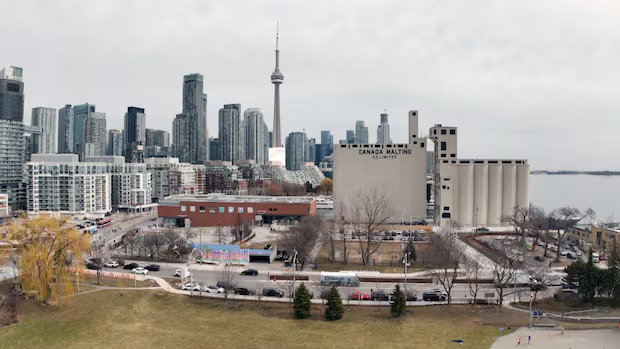
Scientists are raising concerns over ultrafine airborne particles that can enter the bloodstream and may pose serious health risks. (Photo Credit: CBC News)
Residents living near Billy Bishop Airport in Toronto are raising concerns over worsening air quality, as Ontario Premier Doug Ford proposes expanding the airport to accommodate larger jets.
The plan has triggered anxiety in communities already exposed to high levels of pollution, particularly ultrafine particles, which researchers say pose serious health risks but remain unregulated in Canada.
Community Voices Highlight Health Concerns
Residents in the Bathurst Quay neighbourhood, located between the airport and the Gardiner Expressway, say health issues are widespread. Reports of respiratory illnesses, cancers, and other conditions have led many to question the long-term impact of living in the area.
Some residents believe prolonged exposure to poor air quality may be contributing to these conditions, even though scientists caution that direct cause-and-effect links are difficult to establish in individual cases.
What Are Ultrafine Particles?
Ultrafine particles (UFPs) are extremely small pollutants, far smaller than commonly regulated particulate matter like PM2.5. They are primarily produced by combustion sources such as vehicles, aircraft, and industrial activity.
Due to their size, UFPs can penetrate deep into the lungs and even enter the bloodstream, potentially affecting multiple organs, including the brain.
Unlike larger pollutants, UFPs are measured by particle count rather than weight, making them harder to regulate under existing frameworks.
Research Shows Elevated Pollution Levels
Studies conducted by researchers at the University of Toronto found significantly elevated levels of ultrafine particles in the Bathurst Quay area. Monitoring between 2019 and 2022 showed that pollution spikes were particularly high during aircraft takeoffs and landings.
In some instances, particle counts exceeded 100,000 particles per cubic centimetre, far above the 20,000 level considered high by the World Health Organization as a general reference point.
Researchers identified both road traffic from the nearby expressway and airport operations as major contributors.
Health Risks Continue to Mount
Scientific research increasingly links ultrafine particle exposure to a range of health issues, including respiratory diseases, cardiovascular problems, and even neurological conditions.
Studies involving large populations have found associations between long-term exposure and premature deaths, particularly from lung-related illnesses. Canadian research estimates that such pollution contributes to over 1,000 deaths annually in cities like Toronto and Montreal.
Experts emphasise that while individual diagnoses cannot be directly attributed to UFP exposure, the broader patterns are consistent and concerning.
Expansion Plans Raise Alarm
The proposed airport expansion would allow larger jets to operate at Billy Bishop Airport, a move expected to increase both air traffic and emissions.
Critics argue that this could worsen an already challenging environmental situation. Community groups warn that increased fuel use and higher traffic volumes may further elevate pollution levels.
Researchers also caution that larger aircraft typically produce more ultrafine particles, making it difficult to envision the expansion without environmental consequences.
Regulatory Gaps Under Scrutiny
Despite growing evidence, ultrafine particles are not specifically regulated in Canada. Current air quality standards focus on broader particulate matter, which may not fully capture the risks associated with UFPs.
Government agencies acknowledge that research is ongoing, but experts argue that the existing evidence is sufficient to begin developing guidelines or standards.
The lack of regulation has become a central concern for affected communities, who are calling for stronger protections.
A Debate Between Growth and Health
Supporters of the expansion highlight potential economic benefits, while critics question whether those gains justify the potential health risks.
The airport operates under a tripartite agreement involving federal and local authorities, meaning any changes will require broader approval beyond the provincial government.
As discussions continue, the situation reflects a broader challenge faced by urban centres: balancing infrastructure growth with environmental and public health considerations.
What Lies Ahead
For residents, the issue is deeply personal, tied to daily living conditions and long-term health. For policymakers, it presents a complex decision involving economic priorities, scientific uncertainty, and public pressure.
What remains clear is that the debate over ultrafine particles is no longer confined to research circles. It is now shaping real-world decisions that could affect thousands of people.