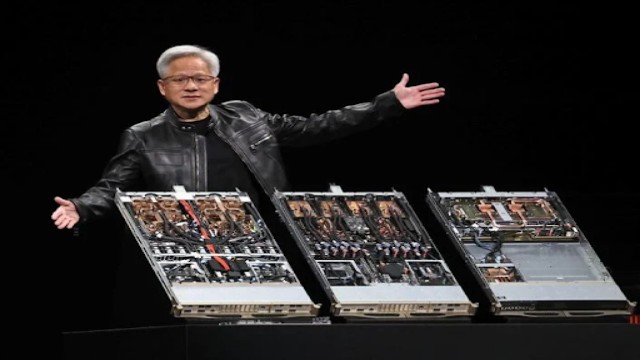
Nvidia President and CEO Jensen Huang speaks at the Computex 2025 tech show held in Taipei, Taiwan (AP Photo/Chiang Ying-ying, File)
In a big development for the global tech industry, Nvidia has confirmed it will restart selling its H20 computer chips to China after receiving approval from the U.S. government. CEO Jensen Huang shared the news while speaking in Beijing and also in a company blog post published late Monday. The chipmaker said it expects to begin shipments soon, following the U.S. administration’s green light for export licenses.
The announcement immediately sparked investor confidence—Nvidia’s stock surged more than 4% by Tuesday afternoon.
The H20 chip is a specialized processor built to run artificial intelligence systems. Although it’s not Nvidia’s most powerful chip, the H20 was designed to meet U.S. export rules, which prevent the sale of more advanced tech to China.
Speaking on China’s CGTN network, Huang said: “Today, I’m announcing that the U.S. government has approved our license filings to start shipping H20s.” He emphasized China’s significance in AI development, stating that about half of the world’s AI researchers are based in the country.
Huang is currently visiting China to attend the China International Supply Chain Expo and has met with key trade officials, including Ren Hongbin, chairman of the China Council for Promotion of International Trade.
Nvidia’s business has soared alongside the AI boom. Just last week, the California-based company became the world’s most valuable, topping a $4 trillion market valuation. However, ongoing tensions between the U.S. and China over tech exports have been a consistent hurdle for companies like Nvidia.
What Makes the H20 Chip Special?
The H20 is a graphics processing unit (GPU) created to follow U.S. trade rules. It’s powerful enough to support AI applications, but not as capable as Nvidia’s top-tier models. Its purpose is to allow Nvidia to serve the Chinese market without breaching export laws.
The U.S. has long limited technology exports to China, citing fears that certain systems designed for civilian use could be repurposed for military objectives. The Biden administration tightened rules in January before Trump returned to office. The updated framework attempted to balance national security and commercial interests.
Despite restrictions, some critics argue the policies contain loopholes and may even push China to innovate faster. A recent example fueling this concern is the debut of DeepSeek, a Chinese-made AI chatbot powered by advanced chips.
Shift in U.S. Policy
In April, the Trump administration had halted sales of the H20 and AMD’s MI308 chips to China, citing national security. Nvidia warned this could cost the company $5.5 billion. Since then, Huang and other tech leaders have worked behind the scenes to ease restrictions.
Their lobbying efforts appear to have paid off. According to a White House adviser, the renewed approval helps the U.S. better compete globally—especially against Chinese tech giant Huawei.
Commerce Secretary Howard Lutnick told CNBC that this decision was tied to a trade deal involving rare earth magnets, essential components in electronics. He added that while sales to China are resuming, the U.S. still isn’t exporting its most advanced technology.
Lawmakers Raise Concerns
Despite this approval, lawmakers remain divided. Last week, Senators Elizabeth Warren and Jim Banks voiced concerns in a letter to Nvidia, warning that high-end AI chips could fuel China’s military modernization. They suggested stronger tracking systems for exported chips to prevent misuse.
Apart from chip-related issues, Nvidia has also been impacted by broader U.S.-China trade tensions, including tariffs. However, both nations have started to ease certain restrictions. China is now allowing rare earth magnet exports to the U.S., while the U.S. has lifted some curbs on chip design tools and jet engines.
U.S. Production Efforts Win Favour
Nvidia’s standing with the Trump administration has improved since it announced plans to manufacture AI chips in the U.S. for the first time. The company is setting up production facilities in Arizona and Texas, covering over a million square feet. These locations will focus on Nvidia’s latest Blackwell chips and AI supercomputers.
Trump praised the move during a White House event, referring to Huang as a “smart cookie” helping to create American jobs.
Following Nvidia’s lead, AMD is also preparing to restart sales of its MI308 chips in China. The company said the Commerce Department is moving forward with its export license requests, and shipments will resume as approvals are granted.