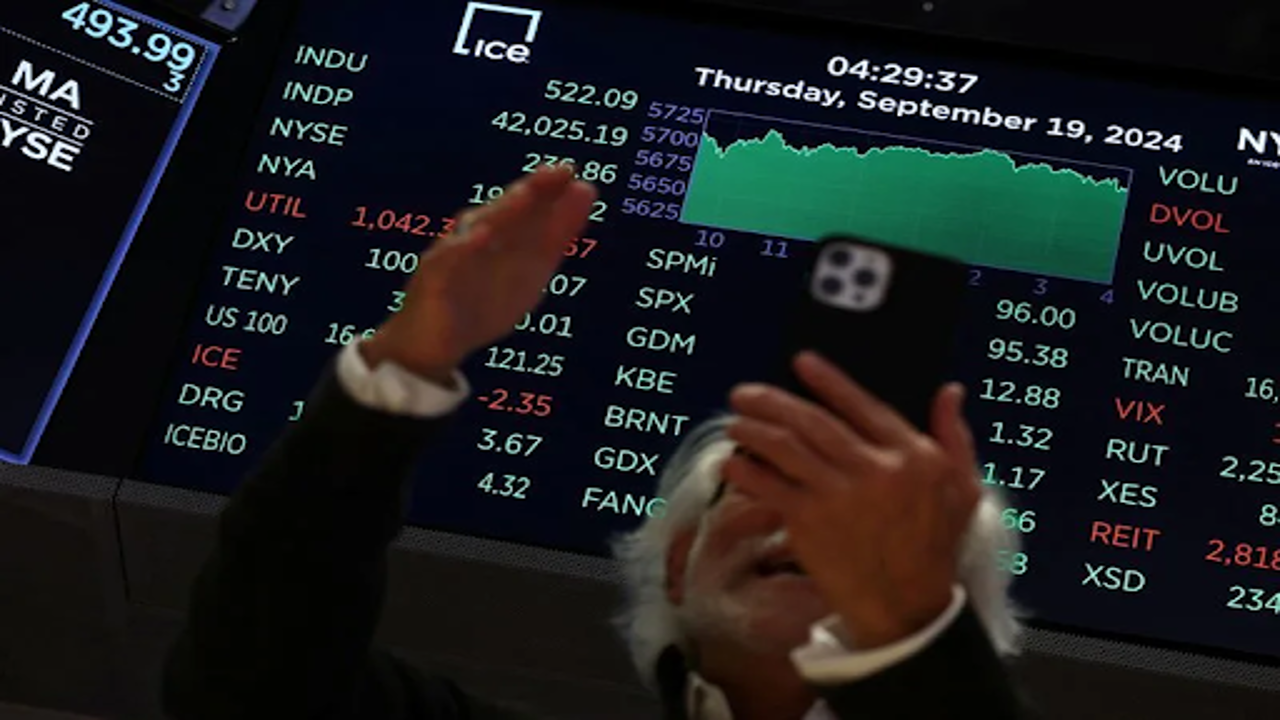
A screen shows the Dow Jones Industrial Average on the trading floor of the New York Stock Exchange in New York.
As the Federal Reserve begins cutting interest rates for the first time in over four years, some investors are cautious about whether U.S. stocks, which have already surged in anticipation, will continue to rise significantly. Despite a positive market response to the 50 basis points rate cut, some experts suggest the benefits of this monetary easing might have already been absorbed by the market.
The S&P 500 hit new records after the rate cut announcement, reflecting investor optimism. Historically, stock markets tend to perform well after the Federal Reserve initiates rate cuts, with an average annual increase of 18% when the economy avoids a recession, according to data from Evercore ISI. However, current stock valuations suggest the potential for further gains may be limited.
In recent months, investors have driven stock prices higher in anticipation of the rate cuts. As a result, the S&P 500 now trades at over 21 times forward earnings, significantly above its long-term average of 15.7. The market’s strong performance this year, with the S&P 500 rising 20%, comes amid weaker-than-expected U.S. job growth. This has led some to believe the upside from lower rates may already be limited.
Robert Pavlik, a senior portfolio manager at Dakota Wealth Management, expressed concerns about the market being up 20% in an environment where economic growth has slowed. Other analysts, such as those from Societe Generale, pointed out that multiple valuation metrics, including price-to-book value and price-to-sales, indicate stocks are trading well above historical averages. U.S. equities are now priced at five times their book value, compared to the long-term average of 2.6.
Lower rates can support stock prices by boosting economic activity and corporate earnings, while also making fixed-income investments less attractive by reducing their yields. The yield on the benchmark 10-year Treasury bond has fallen by about one percentage point since April, currently sitting at 3.7%, though it has increased slightly in recent days. Lower interest rates also make future corporate cash flows more valuable, which typically supports higher stock valuations. However, the price-to-earnings (P/E) ratio for the S&P 500 has already rebounded significantly from lows of 15.3 in late 2022 and 17.3 in late 2023, according to LSEG Datastream, suggesting that much of the rate cut's benefits may already be reflected in stock prices.
Matthew Miskin, co-chief investment strategist at John Hancock Investment Management, noted that equity valuations were already quite high going into the rate cut, making it difficult to see further substantial gains from multiple expansions over the next few years. Instead, Miskin and others believe that stock market growth will be driven primarily by earnings and economic performance going forward. S&P 500 earnings are forecasted to rise by 10.1% in 2024 and 15% in 2025, according to LSEG IBES.
Moreover, some analysts believe the market's strong performance leading up to the rate cuts may have already borrowed gains from future returns. Historically, the S&P 500 has tended to be flat in the year preceding a rate-cutting cycle, but this time, the index is up nearly 27% over the same period, according to Deutsche Bank's Jim Reid. This suggests that some of the potential gains from the current rate-cut cycle may have already been realized.
Still, many investors remain optimistic despite high valuations. Valuations alone are often an unreliable indicator of when to buy or sell stocks, as market momentum can drive prices well above historical norms for extended periods. The S&P 500 traded at a P/E ratio above 22 for much of 2020 and 2021, and during the dot-com bubble in 1999, it reached 25.
Additionally, historical trends show that when the Fed cuts rates while stocks are near their all-time highs, the market tends to perform well in the following year. The Fed has reduced rates 20 times since 1980 while the S&P 500 was within 2% of a record high, and the index has risen each time, with an average annual gain of 13.9%, according to Ryan Detrick, chief market strategist at Carson Group.
Despite concerns, UBS Global Wealth Management analysts expect the stock market to continue performing well, provided the U.S. economy stays out of a recession.