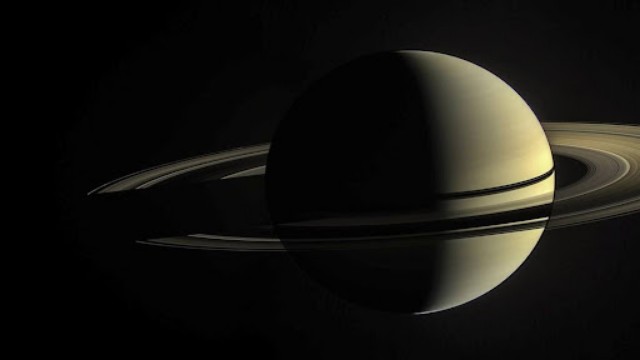
This photo, taken on January 2, 2010, by NASA's Cassini spacecraft, shows Saturn in stunning detail. Released by NASA, the image captures the planet’s beauty from space. (The Canadian Press/NASA/JPL-Caltech/Space Science Institute via AP)
A team of researchers, including Canadian astronomers, has confirmed Saturn’s dominance as the planet with the most moons in the solar system. The team, which includes current and former astronomers from the University of British Columbia (UBC), recently discovered 128 additional moons orbiting Saturn, pushing its total count to 274. This puts Saturn far ahead of Jupiter, which has 95 moons.
The discovery, officially confirmed by the International Astronomical Union, concludes a long-standing debate over which of the two gas giants has the highest number of natural satellites. Edward Ashton, the lead researcher, completed his PhD at UBC and now works at Taiwan’s Academia Sinica Institute of Astronomy and Astrophysics. He stated that based on current data, Jupiter is unlikely to surpass Saturn’s moon count.
Tiny Moons Hold Clues to Saturn’s Past
The newly identified moons are relatively small, some measuring just two kilometres in width. Brett Gladman, a UBC astronomy professor and co-author of an upcoming study on the discovery, believes these small moons are remnants of past collisions. He suggests they likely formed due to crashes between larger moons or passing comets within the past 100 million years.
"If these collisions had occurred billions of years ago, the smaller moons would have been depleted by now," Gladman explained. The presence of so many tiny moons suggests that these cosmic events happened more recently.
A cluster of these newly found moons orbits near a subgroup known as Mundilfari. Astronomers suspect that a catastrophic collision destroyed a larger moon, leaving behind Mundilfari and numerous smaller fragments in similar orbits.
High-Tech Observations Unlock Cosmic Secrets
The researchers used the Canada-France-Hawaii Telescope, a 3.6-meter optical telescope atop Hawaii’s Mauna Kea, to make their discovery. Previously, the same team had identified 62 other Saturnian moons, a finding that helped Saturn overtake Jupiter in moon count in 2023.
Determined to find more, they revisited the same sky fields from September to November 2023. Their persistence paid off, revealing dozens of additional moons. The team employed an advanced “shift and stack” technique, layering multiple images to enhance faint celestial signals along known orbital paths. This meticulous method required patience, but the payoff was significant.
“We pushed the limits of technology to uncover fainter and smaller moons,” said Gladman. “It was six years of dedicated work, but the results are rewarding.”
What’s Next for Saturn’s Moons?
These newly discovered celestial bodies are categorized as “irregular moons,” meaning they follow highly tilted, elongated, and often retrograde orbits around Saturn. As of now, they have not been named, as further verification of their orbits is required by the International Astronomical Union.
Could there be even more moons out there? Gladman believes that while Saturn and Jupiter’s known moon counts have increased dramatically, the current technology has reached its limit in detecting smaller objects. Further advancements may be needed to uncover any remaining hidden moons in our solar system.