The Extremely Large Telescope is being built in Chile's Atacama Desert. BBC
High in Chile’s Atacama Desert, the European Space Observatory (ESO) is working on a groundbreaking project: the Extremely Large Telescope (ELT). Scheduled to begin operation in 2028, this telescope will be the largest optical telescope ever built, designed to revolutionize our understanding of the universe.
One of the key components of this ambitious project is its series of massive mirrors. Dr. Elise Vernet, an expert in adaptive optics at ESO, has been closely involved in developing these mirrors. The ELT will feature five large mirrors, each a marvel of engineering. The most impressive among them is the M1 mirror, the largest ever made for an optical telescope. Measuring 39 meters (128 feet) across, it consists of 798 hexagonal segments that together create a single, seamless surface. This mirror will capture light with an intensity 100 million times greater than the human eye and needs to maintain its shape with an accuracy 10,000 times finer than human hair.
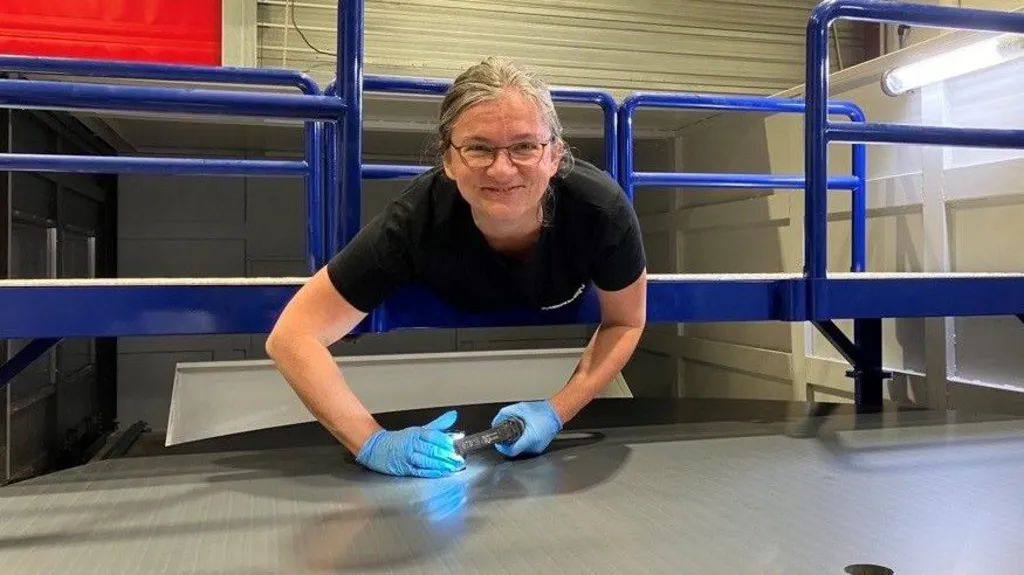
Dr. Elise Vernet examines the M5 mirror. BBC
Another crucial component is the M4 mirror, the largest deformable mirror ever constructed. This mirror can change its shape up to 1,000 times per second to correct distortions caused by the Earth’s atmosphere and vibrations from the telescope. The M4’s surface is made from a thin, glass-ceramic material, and it was crafted by Schott in Germany before being assembled and polished in France.
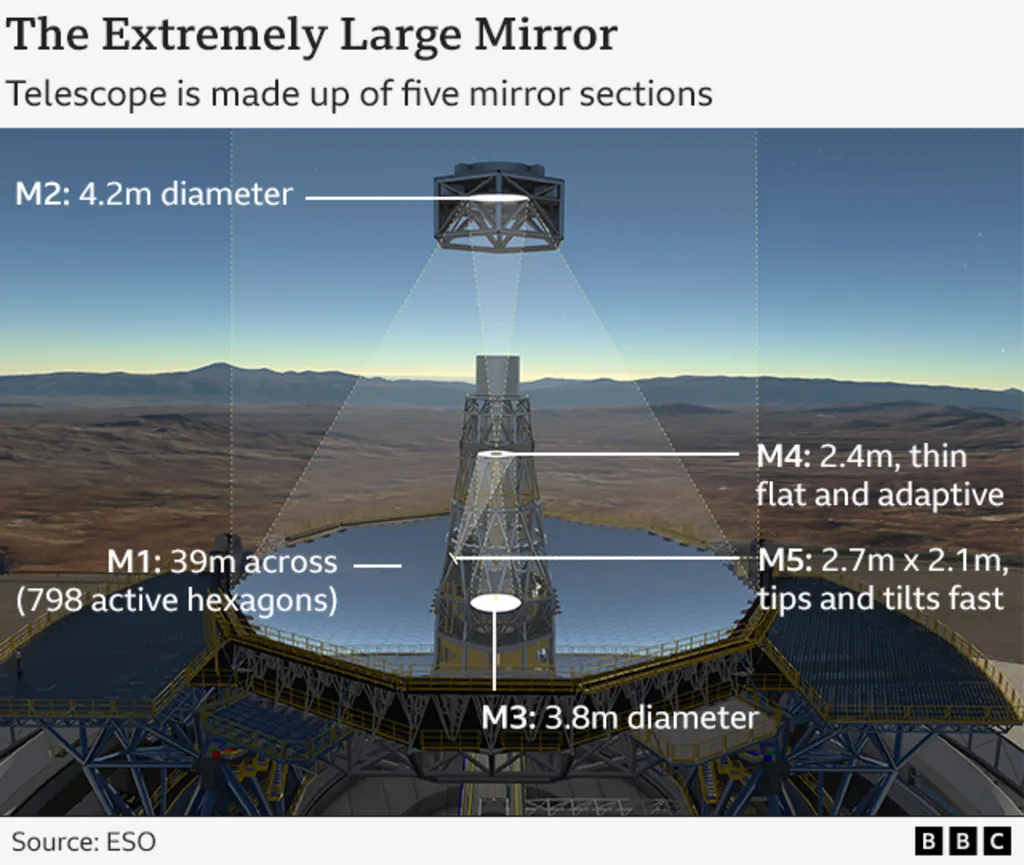
Image source: ESO
The five mirrors, which are nearing completion, will soon be transported to Chile for installation. Once operational, they will help the ELT capture unparalleled images of the cosmos, advancing our knowledge of space.
In a different realm of mirror technology, researchers at the Max Planck Institute for Quantum Optics in Germany have developed a “quantum mirror” made of just 200 aligned atoms. This tiny mirror reflects light by absorbing and re-emitting photons in a predictable direction. This quantum mirror could lead to advances in quantum technologies, such as secure quantum networks for data transmission.
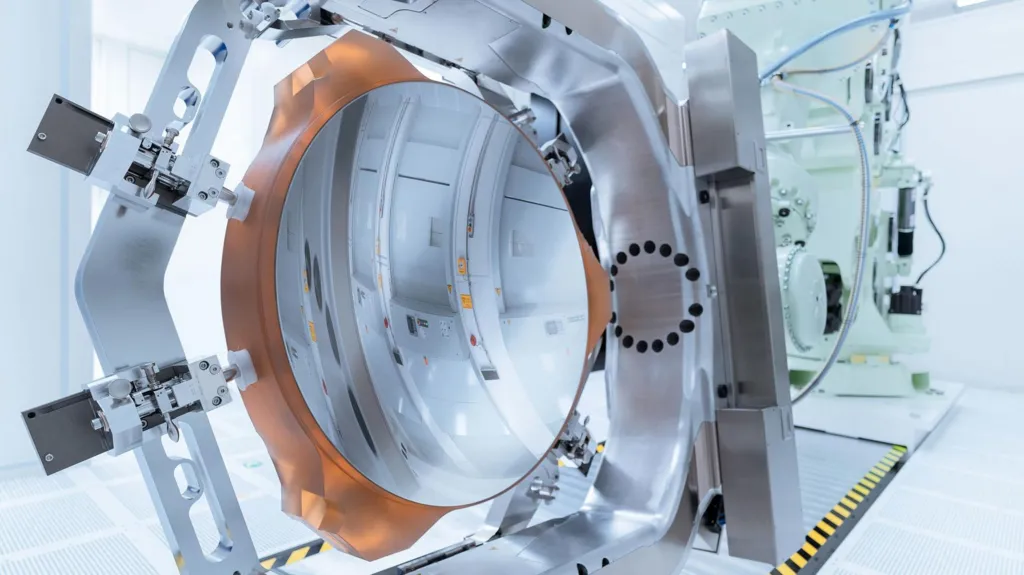
Zeiss in Germany has created the world’s most precise mirror. BBC
Meanwhile, in Oberkochen, Germany, Zeiss is producing ultra-flat mirrors for extreme ultraviolet (EUV) lithography machines used in chip manufacturing. These mirrors are crucial for creating extremely small and detailed features on silicon wafers. Zeiss’s EUV mirrors are so smooth that if scaled up to the size of Germany, the highest point would only be 5 meters. This precision enables the production of more transistors on a chip, pushing the boundaries of current technology.
Zeiss is also working on future improvements to enhance EUV technology, aiming to produce microchips with up to one trillion transistors by 2030. This progress could greatly influence fields like artificial intelligence, making technologies that seem futuristic today a reality in the near future.
As we look ahead, mirrors—whether colossal or microscopic—will continue to play a vital role in advancing technology and deepening our understanding of the universe.