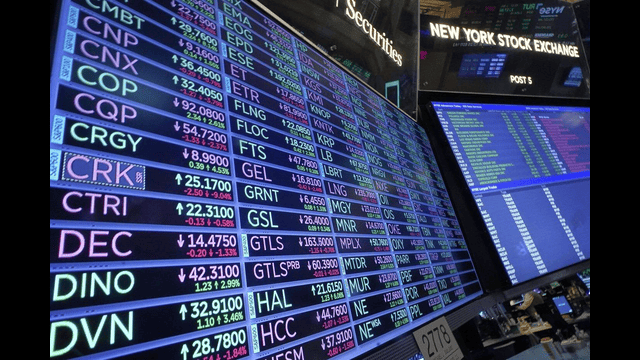
A display board showing stock symbols is seen above the trading floor at the New York Stock Exchange (Photo: AP/Richard Drew)
Canada's main stock market index fell on Friday, following a rocky day for U.S. markets, after former President Donald Trump announced plans to sharply raise tariffs on Canadian imports. His move rattled investors on both sides of the border, although the overall reaction was more restrained than previous episodes of trade drama.
The S&P/TSX composite index closed down 59.05 points, ending the day at 27,023.25. Meanwhile, U.S. markets also dipped. The Dow Jones Industrial Average slid 279.13 points to settle at 44,371.51. The S&P 500 dropped 20.71 points to finish at 6,259.75, and the Nasdaq composite fell 45.14 points to 20,585.53.
Although these losses followed record-setting highs in the previous session, they remained relatively mild compared to sharper drops seen during past trade disputes.
Brian Madden, Chief Investment Officer at First Avenue Investment Counsel, offered a grounded take on the market reaction. He pointed out that while the tariff threats—35% on several Canadian imports—sounded aggressive, the market didn’t panic. In fact, trading volumes were light, and major indexes still hovered near historic highs.
“Markets are starting to understand the game,” Madden said. “This feels more like posturing than policy. You’re not seeing a full-scale retreat in the indexes.”
Trump’s proposed tariff hike was outlined in a letter to Canadian Prime Minister Mark Carney. The letter revealed a plan to increase tariffs on Canadian goods to 35%, building on an earlier 25% rate set back in March. However, later clarification from the White House revealed that the new tariffs would only apply to non-CUSMA (Canada-United States-Mexico Agreement) compliant goods.
The announcement was part of a broader strategy by the U.S. to apply pressure on trading partners by threatening steep import taxes. Even close allies like Canada are not exempt from these tactics, as the U.S. attempts to renegotiate trade terms globally.
Back on Bay Street, losses in the tech sector pulled the TSX down. Still, there were bright spots. Celestica Inc. bucked the trend, with its shares climbing 1.56% by the end of the day. The healthcare sector also slipped, but due to its smaller weight in the index, it had a limited impact overall.
“Financial and industrial stocks took a hit too,” Madden added. “That’s expected in a risk-averse market environment.”
Interestingly, despite the overall dip, more individual stocks on the TSX posted gains than losses. According to Madden, that shows a “tale of two markets”—commodity-linked sectors like oil and gold surged, while other cyclicals lagged.
Indeed, energy commodities stood out. Crude oil for August rose $1.88 to close at $68.45 a barrel. Gold prices also surged, gaining $38.30 to hit $3,364 an ounce.
Another piece of economic news added to the day’s complexity: Canada's job market unexpectedly added 83,000 new positions in June. The unemployment rate nudged down to 6.9%, leading many analysts to believe the Bank of Canada will likely hold interest rates steady at its next meeting.
“I don’t think the Bank of Canada feels forced to cut rates just yet,” Madden concluded. “A neutral stance makes sense given the recent job data.”
The Canadian dollar held steady at 73.08 cents US.