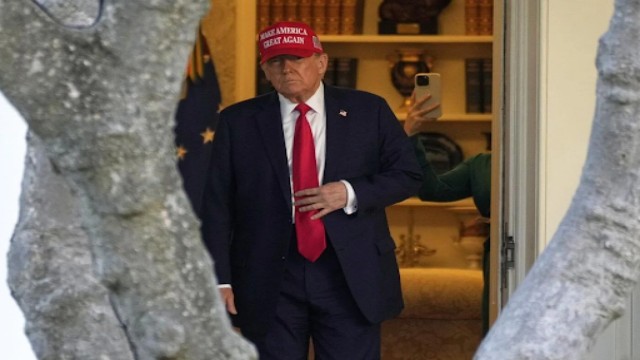
Former President Donald Trump walks across the South Lawn of the White House toward Marine One before departing Washington on February 28, 2025. (AP Photo/Ben Curtis, File)
President Donald Trump has officially implemented a 25% tariff on all steel and aluminum imports, aiming to boost domestic factory jobs. The move, announced Wednesday, removes all previous exemptions and raises aluminum tariffs from 10% to 25%. The decision is part of Trump’s broader trade strategy, which has already impacted stock markets and raised economic concerns.
A Shift in Trade Policy
Trump’s latest tariff changes stem from a February directive and are part of his ongoing efforts to reshape global trade. In addition to targeting Canada, Mexico, and China, he plans to apply similar tariffs on imports from the European Union, Brazil, and South Korea starting April 2. These measures align with his belief that increasing tariffs will push companies to set up factories in the United States.
Speaking to business leaders on Tuesday, Trump claimed his tariff policies were already encouraging investment in U.S. factories. Despite an 8% drop in the S&P 500 over the past month, he remains confident that higher tariffs will ultimately lead to more domestic production.
Trump’s Justification for Tariffs
“The higher it goes, the more likely they are to build,” Trump said, emphasizing that the ultimate goal is to bring manufacturing back to American soil. He argued that even though tariffs generate revenue for the country, the real benefit comes from companies relocating their operations to the U.S. and creating jobs.
Trump briefly considered imposing a 50% tariff on Canadian steel and aluminum but decided to maintain the 25% rate after Ontario halted plans to increase electricity prices for Michigan, Minnesota, and New York.
Tariffs’ Economic Impact
This new round of tariffs marks a continuation of Trump’s 2018 trade policies, which had mixed results. While they initially aimed to protect American steel and aluminum industries, exemptions weakened their effect. For instance, after Canada and Mexico agreed to a revised North American trade deal in 2020, they were no longer subject to the tariffs. Other countries faced import quotas instead of direct tariff charges, and some U.S. companies secured exemptions when domestic alternatives were unavailable.
Though Trump’s tariffs may benefit U.S. steel and aluminum manufacturers, they could also drive up costs for industries reliant on these metals. A 2023 report from the U.S. International Trade Commission found that in 2021, downstream manufacturers lost nearly $3.5 billion due to tariff-related cost increases. This loss outweighed the $2.3 billion gain for aluminum and steel producers.
Uncertain Future for U.S. Manufacturing
Trump argues that tariffs will lead to more domestic factories, and companies like Volvo, Volkswagen, and Honda are reportedly considering expanding their U.S. operations. However, concerns remain that higher costs could hurt sales and profits, discouraging businesses from making long-term investments.
John Murphy, senior vice president at the U.S. Chamber of Commerce, questioned whether executives would be willing to expand production amid economic uncertainty. “If you’re in the boardroom, are you really going to tell your investors it’s time to build another assembly line?” he asked.