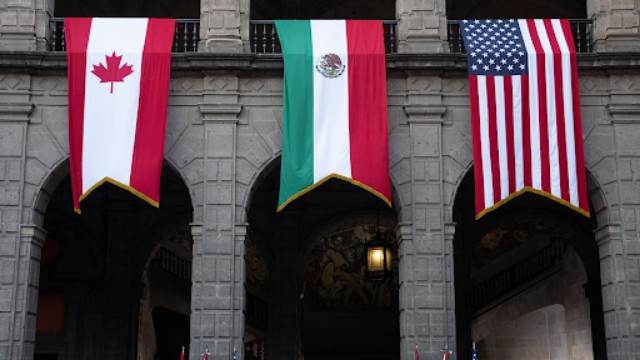
The national flags of Canada, Mexico, and the United States are displayed on a building. (Adrian Wyld/The Canadian Press)
The ongoing trade war sparked by U.S. President Donald Trump’s tariff policies is expected to weaken economic growth in the United States, Canada, and Mexico while increasing inflation, according to the Organisation for Economic Cooperation and Development (OECD). In its latest economic outlook, the Paris-based organization warned that escalating trade disputes could further slow the global economy.
Tariffs to Hit Growth in North America
The OECD predicts that the U.S. economy will decelerate due to higher tariffs, which are expected to increase the cost of imports and reduce business investments. The American economy is forecast to grow at 2.2% in 2024 before slowing to just 1.6% in 2025. This is a downgrade from earlier projections of 2.4% and 2.1%, respectively.
Canada will also feel the impact, with economic growth expected to slow to 0.7% this year and next—well below the previous forecast of 2% for both years. Meanwhile, Mexico is projected to take the hardest hit, with its economy shrinking by 1.3% this year and 0.6% next year. Earlier predictions suggested that Mexico would grow by 1.2% and 1.6%, making this a significant downward revision.
Global Growth to Take a Hit
The OECD expects worldwide economic expansion to slow slightly, from 3.2% in 2024 to 3.1% in 2025 and 3.0% in 2026. This is a downgrade from its December forecast, which predicted 3.3% growth for both 2024 and 2025.
However, not all economies will suffer equally. While North America faces a downturn, China is expected to remain resilient, largely due to strong government support. The Chinese economy is projected to grow by 4.8% in 2025, slightly up from previous estimates, before slowing to 4.4% in 2026. Meanwhile, the Eurozone, which has been less affected by U.S. tariff policies, is expected to grow by 1.0% this year and 1.2% next year, slightly lower than prior forecasts.
Tariff Hikes Could Prolong Inflation
Higher tariffs are likely to push up inflation by increasing the cost of goods, leaving central banks with little choice but to maintain higher interest rates for a longer period. This means borrowing costs will remain high, further slowing investment and economic expansion.
The OECD has based its predictions on the assumption that the U.S. will impose an additional 25% tariff on nearly all imports from Canada and Mexico starting in April. If the trade war escalates further, with Washington raising tariffs on all non-commodity imports and other nations responding in kind, the impact on global growth could be severe.
Potential Consequences for U.S. Households
If tariffs rise by 10 percentage points across the board, global growth could slow by an additional 0.3 percentage points, and inflation could increase by 0.4 percentage points over the next three years. The OECD estimates that American households could face additional costs of up to $1,600 per year, with economic losses outweighing the revenue generated by tariffs.