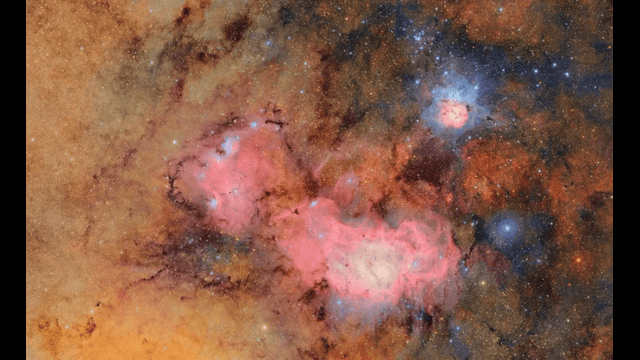
The Vera Rubin telescope’s first photo captures the Trifid and Lagoon nebulae in incredible detail. BBC
A powerful new telescope in Chile has taken its first pictures of deep space. The Vera C. Rubin Observatory has shown its strength by capturing detailed views of gas and dust clouds 9,000 light-years from Earth. These clouds are part of a region where new stars are forming.
This telescope holds the most powerful digital camera ever built. Scientists believe it will help us discover many secrets of the universe.
Built to Spot the Unknown
Experts say the telescope can do amazing things. If a ninth planet exists in our solar system, this telescope could find it within a year. It can also spot dangerous asteroids that might come near Earth.

A massive group of galaxies, including spirals, lies in the Virgo cluster, which is around 100 billion times larger than our Milky Way. BBC
In just 10 hours, the telescope detected 2,104 new asteroids and seven space objects close to Earth. That’s a big deal—most surveys find only 20,000 asteroids in a whole year.
Over the next 10 years, it will film the southern sky nonstop, tracking changes and movement in space.
Designed for Clarity and Speed
The Vera Rubin Observatory sits on a high mountain in the Chilean Andes. The location is perfect—dry, dark, and quiet. These are ideal conditions for watching the stars.
Inside, every part of the observatory helps keep things dark and clear. Engineers even turn off tiny lights that could interfere with space images.

The Vera Rubin telescope's 3,200-megapixel camera was created by the SLAC National Accelerator Lab in the United States. BBC
The telescope uses a special three-mirror system to collect light. The mirrors must stay clean, as even one speck of dust could ruin a photo.
The camera is huge—3,200 megapixels—and takes a picture every 40 seconds for up to 12 hours each night. It captures more detail than 400 Ultra HD TVs could show at once.
Watching the Sky Like Never Before
Scientists say this telescope will completely change how we explore space. It can spot faint galaxies, dying stars, and distant objects.
Four main missions drive this project:
- Watching objects that change or move in the sky
- Studying how the Milky Way formed
- Mapping all known solar system objects
- Understanding dark matter and how the universe began
When something changes in the sky, the telescope sends an alert. Scientists around the world will study this data. At its peak, they may get 10 million alerts in one night.

The Telescope Mount Assembly holds the large mirrors and the camera in place. BBC
What It Could Discover
Some experts think Vera Rubin might find Planet Nine—if it exists. This hidden world could be 700 times farther from the Sun than Earth.
Professor Alis Deason hopes the telescope will show the edges of our galaxy. Right now, data goes out to 163,000 light-years. With this new tool, they may see as far as 1.2 million light-years.
She also wants to study stars destroyed over time and small galaxies that are still hiding.
Professor Catherine Heymans, who has worked on this for 25 years, said, “It’s going to be amazing.”