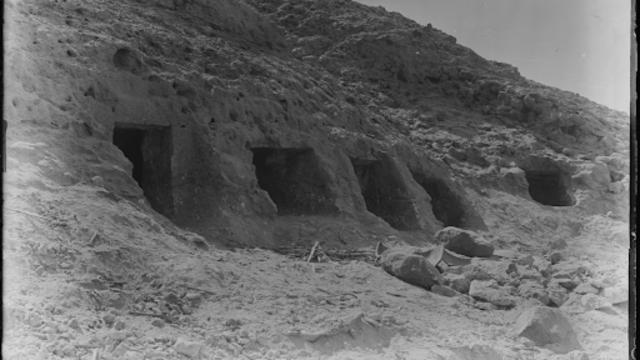
Researchers shared a photo showing tombs carved into rock at Nuwayrat, Egypt. Inside one tomb, they found a clay pot containing a man's remains. Tests show the man lived between 2855 and 2570 BCE. AP
Scientists have uncovered a strong genetic connection between ancient Egypt and Mesopotamia. They discovered this link by studying the DNA of a well-preserved skeleton found in an Egyptian tomb.
The results were published in a leading science journal on Wednesday. The skeleton, sealed inside a funeral pot, dates back about 4,500 to 4,900 years.
What the DNA shows
Researchers studied the man's full genome from his teeth. Most of his DNA—about 80%—linked to North Africa, including Egypt. But 20% of his DNA showed roots in the Fertile Crescent. This area, between the Tigris and Euphrates rivers, was the heart of ancient Mesopotamia.
Experts say this is the first clear genetic evidence showing a link between the two early civilizations. Past studies had hinted at connections, but this DNA study confirms them.
Shared culture and trade
Historians have long believed Egypt and Mesopotamia traded goods and shared ideas. They had similar pottery styles and writing systems. Even their teeth showed some common features. Now, this new study adds DNA proof to those earlier signs.
A museum expert called the findings “highly significant.” He said it confirms what many researchers had suspected for years.
The Nile as a bridge
Experts believe the Nile River played a key role. One scientist called it an “ancient superhighway.” It likely helped people, goods, and ideas move between different regions.
This made it easier for people from Mesopotamia to reach Egypt, and vice versa.
Who was the man in the tomb?
The skeleton belonged to a man who likely lived in his 60s. His joints showed signs of arthritis, especially in areas used often by potters. Experts think he may have worked with clay or made pottery.
His tomb was located in Nuwayrat, a site carved into a rocky hillside. He lived during a very important time in Egyptian history—just before or at the start of the Old Kingdom.
This was the period when Egypt united as one nation and began to build the famous pyramids.
What was happening in Mesopotamia?
At the same time, city-states were growing in Mesopotamia. They also developed a writing system called cuneiform. Both regions were seeing huge cultural changes and growth.
More DNA research needed
While this discovery is important, scientists say it’s only the beginning. They need to study more skeletons from both regions. This will help them understand when and how people moved between Egypt and Mesopotamia.