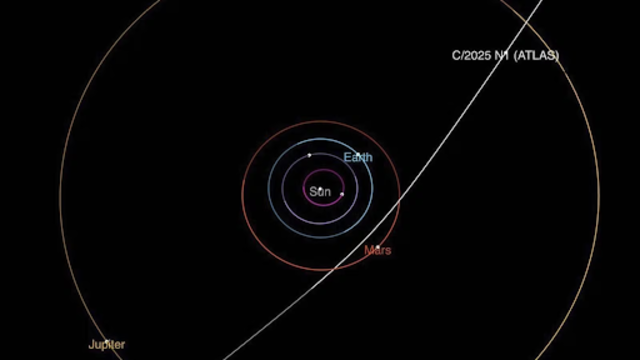
This image from NASA shows the path comet 3I/ATLAS will take as it travels through our solar system. NASA
A comet from another star system has entered our solar neighborhood. NASA confirmed the find after spotting the object with its Atlas telescope in Chile earlier this week. Scientists say this is only the third known interstellar object ever seen passing through our solar system.
No Danger to Earth
The comet, now named 3I/Atlas, does not pose any danger to Earth. It's currently near Jupiter, about 416 million miles from the sun, and it's heading inward at a high speed of 37 miles per second. NASA said it will make its closest pass to the sun in October. It will travel between Mars and Earth’s orbits, staying a safe distance of about 150 million miles from our planet.
Millions of Years in the Making
“This thing has likely been traveling through space for hundreds of millions of years, maybe even billions,” said Paul Chodas, who leads NASA’s Center for Near Earth Object Studies. He explained that while the comet is moving fast, there’s no way to know exactly where it came from.
What We Know So Far
Astronomers have already made more than 100 observations since the comet was first seen on July 1. The icy object seems to have a tail and a cloud of dust and gas around it, signs that it’s a typical comet. Based on its brightness, scientists believe 3I/Atlas could be several miles wide. It also seems bigger and faster than the previous interstellar visitors.
When Can You See It?
People using telescopes might be able to catch a glimpse of the comet through September. It may disappear for a short time when it gets too close to the sun, but scientists expect it to become visible again by December as it moves to the other side of the sun.
Past Interstellar Visitors
The first interstellar object spotted from Earth was Oumuamua in 2017. At first, experts thought it was an asteroid, but it later showed features of a comet. Then, in 2019, 21/Borisov was discovered by an amateur astronomer. That one clearly behaved like a comet too.
Excitement in the Space Community
Paul Chodas said scientists have waited a long time to see more of these rare objects. “A visitor from another solar system, even though it’s natural — it’s not artificial, don’t get excited — it’s just very exciting,” he said.