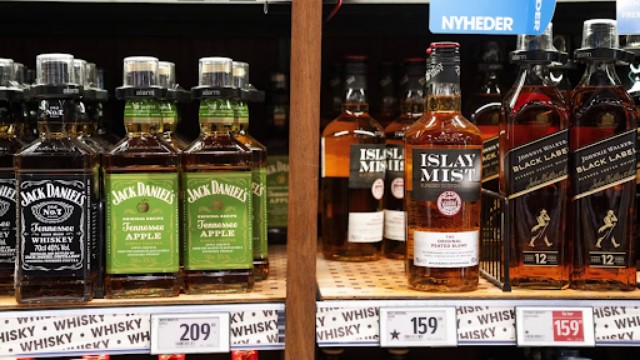
Bottles of liquor marked with a star are seen on display at Bilka in Randers, Denmark, helping shoppers easily identify European-made products. (Bo Amstrup/Ritzau Scanpix via AP)
The European Union is bracing for a crucial update from the United States on potential new tariffs that could deeply impact global trade. On Monday, the EU expects to learn whether President Donald Trump will move forward with steep tariffs targeting European goods—a decision that could ripple through industries and wallets on both sides of the Atlantic.
In early April, the Trump administration introduced a 20% import tax on goods from the EU. However, the rate was temporarily reduced to 10% to calm markets and allow time for negotiations. This grace period ends on July 9. Trump has since warned that tariffs could soar to 50% if discussions don’t go his way, making popular European imports—like French cheese, Italian leather, German electronics, and Spanish medicines—much costlier in the U.S.
The EU's executive arm, which handles trade talks, hopes to secure a deal to prevent further disruption. If no agreement is reached, the block is prepared to strike back with its own tariffs targeting a wide range of American goods—beef, auto parts, beer, and even Boeing jets.
Speaking on CNN, U.S. Treasury Secretary Scott Bessent acknowledged the EU’s slow start in negotiations, but said talks are now progressing well.
A Massive Trade Relationship at Stake
Trade between the U.S. and the EU is one of the largest in the world. In 2024, their exchanges reached $2 trillion, averaging over $5 billion in daily trade. America’s top exports to Europe include crude oil, pharmaceuticals, airplanes, and vehicles. In return, Europe ships cars, chemicals, medical tools, wine, and spirits to the U.S.
Despite this active exchange, Trump has pointed to a trade gap: the EU sells much more to the U.S. than it buys. The goods trade imbalance stands at €198 billion. Still, American firms earn more from services like tech, legal, and finance, which narrows the overall deficit to €50 billion.
Tensions Behind the Talks
Before Trump's return to office, the U.S. and EU enjoyed mostly low tariffs and smooth relations. But since February, the U.S. has imposed or threatened several new tariffs, including 50% on steel and aluminum, and 25% on auto imports.
U.S. officials are pushing back on EU rules regarding food safety—like bans on hormone-treated meat and chlorine-washed chicken. Trump has also criticized Europe's value-added taxes (VAT), though economists say these taxes apply equally to all products, imported or domestic.
Experts note that Europe can't easily compromise on many of these points. The structure of the EU’s internal market limits how much it can bend to American demands.
Impact on Businesses and Consumers
Higher tariffs could mean higher prices. While some companies may absorb the cost, others will likely raise prices. Mercedes-Benz, for instance, said U.S. prices might stay flat for now but could rise in the future.
Campari, the Italian drinks brand, may adjust prices depending on competitors’ decisions. Meanwhile, luxury powerhouse LVMH has hinted it may move more production to the U.S. if tariffs persist.
Economists warn this trade fight could hit the U.S. harder than Europe. Without a deal, U.S. economic output might drop by 0.7%, while the EU could lose 0.3% of its GDP.
Even if both sides manage to strike a basic deal, higher tariffs may linger. Still, experts believe that Trump might roll back his harshest threats to avoid deep economic damage. In the end, U.S. consumers may bear the brunt of the protectionist push.