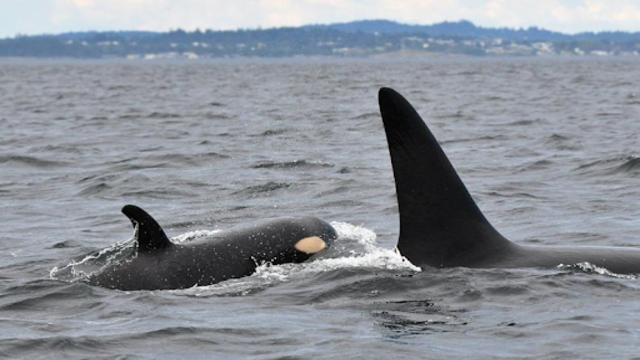
A young southern resident killer whale (left), shown in a handout photo, spotted swimming in the waters off the west side of Vancouver Island. THE CANADIAN PRESS/Handout - Centre for Whale Research
A new report paints a grim picture for southern resident killer whales living off the coasts of British Columbia and Washington. Despite efforts by Canada and the U.S. since 2019, the whales show no signs of recovery. Scientists now say only bold, immediate action can save them from extinction.
Time is Running Out
The report, released by the David Suzuki Foundation and Raincoast Conservation Foundation, warns that current conditions pose a “high probability of extinction” for this critically endangered population. Only 73 individuals remain, and without stronger protections, experts fear they won’t survive.
Southern resident orcas are genetically unique. They’re culturally significant to Indigenous communities and have been studied closely for decades. Unlike other orcas, they rely almost entirely on chinook salmon—especially the largest, fattiest fish found early in the season.
Not Just Another Report
This is the first time scientists from Canada, the U.S., and Europe have come together to map out a detailed plan for orca recovery on both sides of the border. Thirty-one experts participated in a March workshop in Vancouver, laying out 26 science-based recommendations to give the whales a fighting chance.
The list includes:
- Fishing closures to give orcas priority access to chinook salmon
- Stronger limits on ocean pollution, including greywater and sewage
- Enforceable rules to reduce underwater ship noise
- Expanded no-go and slowdown zones for vessels
- Clear thresholds for prey availability each season
Slow Progress, Rising Risks
Lance Barrett-Lennard, a scientist with Raincoast, said there's no real evidence the whales are bouncing back. While some measures may have helped slow their decline, the population is still dangerously low. A single oil spill or disease outbreak could have devastating consequences.
What makes things harder is the whales’ slow reproductive rate. They live long lives and reproduce infrequently. So even if better protections are adopted now, visible recovery could take years—possibly decades.
Missed Opportunities and Delays
Despite recognizing the urgency, the federal government stopped short of issuing an emergency protection order earlier this year. Instead, it promised to "strengthen" existing measures. So far, no timeline or details have followed.
Barrett-Lennard says Ottawa’s delay is troubling. Without real changes soon, the population may slip past the point of recovery.
More Than Just Whales
These orcas are not just wildlife—they’re individuals with distinct personalities, complex social structures, and deep family bonds. Barrett-Lennard says once we recognize them as individuals, the need to protect them becomes personal.
“They have huge brains,” he says. “They know each other. They know the coastline. They remember.”
The whales’ survival, he adds, is tied not just to policy, but to our willingness to act before it’s too late.