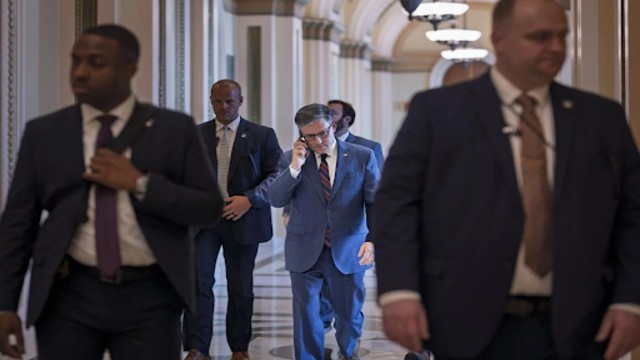
Speaker of the House Mike Johnson, R-La., leaves the chamber at the Capitol in Washington, Thursday, July 17, 2025. (AP Photo)
In a tight vote split along party lines, the U.S. Congress has approved a Republican-backed bill cutting nearly $9 billion from public broadcasting and foreign aid. The measure, proposed by former President Donald Trump, passed the Senate 51-48 and the House 216-213. It now awaits the president’s signature.
This move revives a rarely used budgetary tool that lets a president cancel previously approved funding. The aim? To redirect spending and trim what Republicans call “wasteful” programs. Democrats pushed back but couldn’t sway enough Republicans to block the bill.
Public Broadcasting Takes a Hit
One of the biggest cuts targets the Corporation for Public Broadcasting (CPB)—a key supporter of public TV and radio in the U.S. Nearly $1.1 billion will be rescinded, essentially wiping out funding for the next two years.
Why the cut?
The Trump administration claims public media carries political bias and is an unnecessary burden on taxpayers. Over 70% of CPB funds go to more than 1,500 local stations. The rest supports national shows on NPR and PBS.
Senator Ted Cruz called public broadcasting a haven for “partisan activists.” But not everyone on the right agreed.
Senator Mike Rounds, a Republican from South Dakota, secured a deal to protect Native American public radio stations. Some of their funding will now come through the Interior Department. Still, many worry rural communities will be the first to feel the pain.
Senator Tammy Baldwin of Wisconsin voiced her concern in a failed attempt to block the cuts. “If this goes through,” she warned, “rural stations will shut down first.”
What Triggered the Cuts?
Republicans justify the decision by pointing to specific programs they oppose.
Russ Vought, the White House budget director at the time, criticized media content he called inappropriate or unnecessary. His examples included:
- An NPR show discussing sexuality in animals
- A CNN “Sesame Street” town hall about racism
- DEI (Diversity, Equity, Inclusion) initiatives
To conservative lawmakers, these examples painted a picture of biased or nonessential spending.
Billions Pulled from Foreign Aid
Most of the bill’s cuts come from foreign assistance—with nearly $8.3 billion initially on the chopping block. That was later reduced to $7.9 billion after a bipartisan push to protect PEPFAR, the U.S.-led global HIV/AIDS program.
Here’s what else is being slashed:
- $500 million from global health efforts, including maternal care and infectious disease control
- $800 million from refugee services like shelter, sanitation, and reunification programs
- $4.15 billion from economic and democratic development projects in key regions
- $496 million from disaster relief and humanitarian aid
- $361 million from international peacekeeping missions
The administration argued that these cuts will encourage global organizations to become less dependent on U.S. aid and seek funding from other nations.
Even UNICEF wasn’t spared. Trump’s team framed the move as a push for accountability—insisting it puts “American taxpayers first.”
A Divided Congress, A Divided Impact
This bill reflects growing tension in Washington over how—and where—public money should be spent.
Supporters see it as a long-overdue reset of priorities. Critics warn that cutting public broadcasting and foreign aid undermines communities at home and weakens America’s influence abroad.
For many, the consequences will be felt not in headlines, but in silenced radio stations, struggling refugees, and fragile democracies left with less support.
This bill isn’t just about dollars. It’s about the values behind the budget—and the price of cutting them.