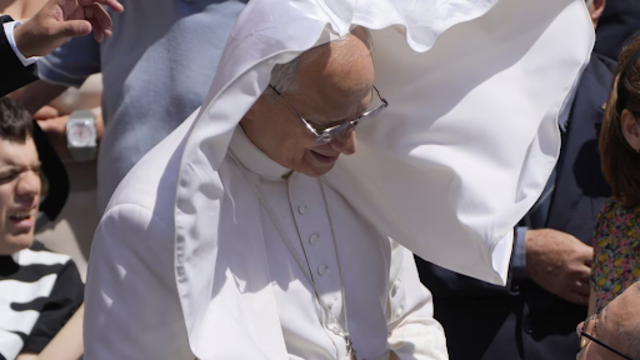
A strong breeze lifted Pope Leo XIV’s robe as he finished the midday Angelus prayer outside the Apostolic Palace in Castel Gandolfo, Italy, on Sunday, July 20, 2025. AP Photo
Pope Leo XIV marked the 56th anniversary of man's first steps on the moon with a special visit and a meaningful phone call. On Sunday, he visited the Vatican's astronomical observatory and later spoke with Apollo 11 astronaut Buzz Aldrin.
Observatory Tour in Castel Gandolfo
After saying the Angelus prayer at his summer home in Castel Gandolfo, the pope walked to the Vatican Observatory nearby. This observatory has been part of the church’s efforts to connect faith with science for many years.
He explored the telescopes and other equipment used for studying the skies. He also met astronomers and students who were attending the observatory’s summer school program.
This visit marked Pope Leo's first time inside the observatory, which was officially founded in 1891 by Pope Leo XIII. The idea of studying the heavens through science in the Church, however, goes back to 1582, when Pope Gregory XIII started a group to help create the modern calendar.
A Historic Phone Call
Later that evening, Pope Leo spoke on the phone with Buzz Aldrin, one of the first humans to walk on the moon in 1969 along with Neil Armstrong. They talked about the importance of the moon landing and how it remains a powerful moment in human history.
The pope posted about the call on social media. “Together we shared the memory of a historic feat, a testimony to human ingenuity, and we reflected on the mystery and greatness of Creation,” he wrote.
He also gave his blessing to Aldrin, his family, and everyone who helped make the Apollo 11 mission possible.
Pope and Space: A Long Connection
Popes have shown interest in space for many years. In 2011, Pope Benedict XVI called astronauts on the International Space Station. He asked them about caring for the Earth and protecting the environment.
Back in 1969, Pope Paul VI sent a radio message to the Apollo 11 astronauts while they were on the moon. He called them “conquerors of the Moon.”
The Vatican Observatory continues to play a role in space research. It is well known for its meteorite collection, including samples from Mars. Many scientists visit the observatory to learn more about the universe from both a scientific and spiritual view.