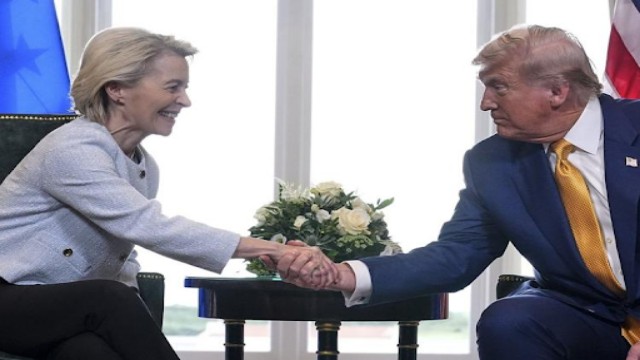
U.S. President Donald Trump and European Commission President Ursula von der Leyen shook hands after finalizing a trade agreement at the Trump Turnberry golf resort in Turnberry, Scotland, on Sunday, July 27, 2025. (AP Photo/Jacquelyn Martin)
The United States and the European Union have finally struck a deal to settle a brewing trade standoff, agreeing to a 15% tariff on most goods traded between them. President Donald Trump and European Commission President Ursula von der Leyen announced the breakthrough after a brief but crucial meeting at Trump’s Turnberry golf course in Scotland. This pact, reached just ahead of the White House’s looming tariff deadline, pulled both powers back from the brink of a full-blown trade war.
Trump praised the agreement as a “giant deal with lots of countries,” saying it’s a win for both sides. Von der Leyen echoed his tone, calling it a move that will bring “stability and predictability”—key for businesses on both sides of the Atlantic.
What's in the Deal?
As part of the agreement, the EU will:
- Purchase $750 billion worth of U.S. energy.
- Invest an additional $600 billion in American ventures.
- Place significant orders for U.S. military equipment.
Both sides agreed to lock in a universal 15% tariff on automobiles and other major goods. Trump claimed, “The European countries are now open to us,” while von der Leyen confirmed that the tariffs are “across the board.”
Behind Closed Doors at Turnberry
Trump, fresh off his second day of golf at Turnberry, took a break to sit down with von der Leyen. While the meeting was short, it was the final step after months of tense negotiations. The looming threat of a 30% tariff—previously floated by the Trump administration—had pressured both parties into fast-tracking talks.
Trump has long argued that past trade deals have been tilted against the U.S. “I think both sides want to see fairness,” he said. Von der Leyen added that the U.S. and EU together represent the largest trade volume in the world and described Trump as a “tough negotiator”—to which he quickly added, “But fair.”
Last-Minute Save from Deadline Disaster
The timing was tight. The Trump administration had made it clear that without a deal, tariffs would begin on August 1—no more delays. U.S. Commerce Secretary Howard Lutnick reaffirmed this on national TV, saying, “No extensions, no more grace periods.”
If the deal had fallen apart, the EU was ready to hit back. Planned retaliation included tariffs on hundreds of American products like beef, beer, airplane parts, and even auto components. Prices for everyday goods from Europe—French cheese, German electronics, Italian leather—would likely have jumped for U.S. consumers.
Trump’s Scotland Tour Continues
While serious diplomacy was happening behind the scenes, Trump also kept his golf-centric schedule intact. After hosting von der Leyen, he played another round with sons Eric and Donald Jr. Protesters gathered at the course with signs criticizing British PM Keir Starmer, who is also scheduled to meet Trump at Turnberry.
Trump’s Scottish itinerary will continue into Tuesday in Aberdeen, where the Trump family owns another golf course and is preparing to launch a third. Trump and his sons are expected to attend the ribbon-cutting ceremony.
EU Negotiators at the Table
Von der Leyen was joined by key EU officials:
- Maros Sefcovic, EU’s chief trade negotiator
- Björn Seibert, her Cabinet head
- Sabine Weyand, EU trade director
- Tomas Baert, the EU’s U.S. agriculture and trade chief
Their presence showed the weight of the moment. A similar deal had been within reach earlier this month, but stalled when Trump reignited threats of a steeper tariff.
Now, both sides have something to show: a deal that avoids a dangerous economic shake-up while boosting trade cooperation.