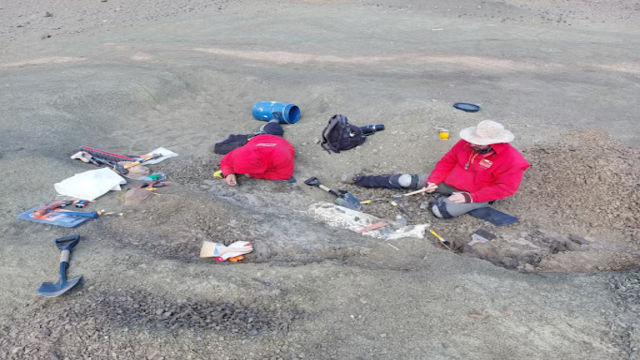
This image, taken by researcher Hans Püschel and released by the University of Chile on August 11, 2025, shows paleontologists at work in Chile’s Río de las Chinas Valley, Magallanes region, on February 17, 2024. During the expedition, scientists uncovered the fossil of a mouse-sized mammal that once lived in Chilean Patagonia alongside dinosaurs. AFP
Scientists in Chile have found the fossil of a mouse-sized mammal that lived alongside dinosaurs about 74 million years ago. The creature, named Yeutherium pressor, weighed only 30 to 40 grams—around the size of a large mouse. This is the smallest mammal ever discovered in this part of South America.
Tracing Back to the Age of Dinosaurs
The mammal lived during the Upper Cretaceous period, a time when South America was still part of the giant landmass Gondwana. Its remains were discovered in the remote Rio de las Chinas Valley, in Chile’s Magallanes region, nearly 3,000 kilometers south of Santiago.
What the Fossil Reveals
The fossil includes a small piece of jaw, one complete molar, and the crown and roots of two other molars. Hans Puschel, who led the research team from the University of Chile and Chile’s Millennium Nucleus research center, said these findings give valuable insights into early mammals in the region. The research appeared this month in the scientific journal Proceedings of the Royal Society B.
A Unique Type of Mammal
Although it looked like a tiny rodent, Yeutherium pressor was quite different. Scientists believe it either laid eggs, like the platypus, or carried its young in a pouch, similar to kangaroos or opossums. Its teeth suggest it fed on hard vegetables, showing it had adapted to a specific diet in its prehistoric environment.
Extinction Alongside Dinosaurs
The little mammal lived in the same environment as dinosaurs and faced the same fate. It disappeared about 66 million years ago when a mass extinction event wiped out the dinosaurs and many other species.