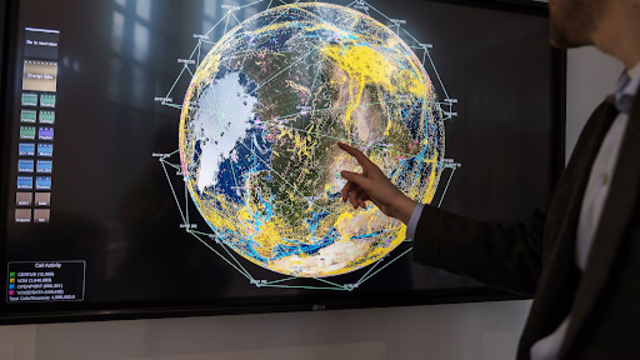
At the Iridium Communications Satellite Network Operations Centre in Leesburg, Virginia, a staff member points to a screen showing satellites currently in orbit and live communications taking place around the world. (Getty Images)
Satellites that provide GPS, communication, and navigation services face greater threats in the coming decades. A new study shows that climate change is altering Earth’s upper atmosphere in ways that make satellites more vulnerable to solar-triggered geomagnetic storms.
Researchers found that the growing amount of carbon dioxide in the atmosphere is making the air thinner at higher altitudes. When geomagnetic storms strike, they suddenly increase density in those layers. These rapid shifts can cause major issues for satellites, including difficulty staying in orbit and even the risk of falling closer to Earth.
Why Solar Storms Matter
Geomagnetic storms happen when charged particles from the Sun hit Earth’s upper atmosphere. The most visible result is the aurora, which paints the skies with brilliant green, purple, and pink lights. But storms also create serious problems for satellites.
They make the thin upper atmosphere thicker for short periods. That change increases drag, which forces satellites to slow down and lose altitude. This reduces their lifespan and can disrupt critical services.
Researchers warn that later this century, storms of the same intensity we see today will cause bigger spikes in density because the atmosphere will already be less dense overall.
The Study’s Findings
Scientists used a powerful supercomputer to simulate Earth’s entire atmosphere and test how future storms could impact satellites. They used a strong solar storm from May 2024 as a reference. That event, caused by coronal mass ejections from the Sun, disrupted satellites and created unusually widespread northern lights.
The simulations looked at similar events in 2040, 2061, and 2084. Results showed that by the end of the century, the upper atmosphere could be 20 to 50 per cent less dense at the peak of such storms. The density changes could shift from doubling to tripling during these events.
Lead author Nicholas Pedatella explained: “If you have a really big increase in density, then the satellite kind of comes down closer to Earth.” He stressed that satellites being built today must prepare for future conditions, not rely on old calculations.
Impacts on Satellites and Space Junk
A thinner atmosphere normally reduces drag, allowing satellites to last longer. While this might sound like a benefit, it also worsens the problem of space debris. Without drag to naturally clear space junk, more objects could crowd low Earth orbit, raising the risk of collisions.
But during solar storms, the rapid spikes in density could drag satellites down unexpectedly, putting critical systems at risk. This could threaten navigation, communications, and even military operations on Earth.
Pedatella noted that climate change is reshaping how engineers should think about satellites: “In 30 years from now, that magnitude of storm will have a potentially different magnitude of response.”