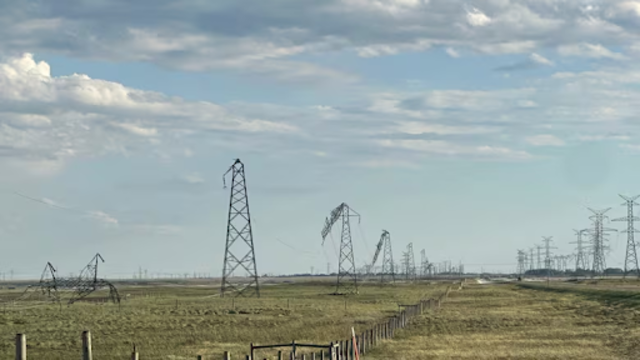
On Wednesday, a storm swept through southeastern Alberta, knocking down power lines and causing damage to transmission towers. CBC
A powerful thunderstorm tore through southern Alberta on Wednesday, leaving behind a trail of damage. The storm brought down power lines, damaged vehicles, and caused widespread outages. Communities across the region faced dangerous conditions as the system pushed east into Saskatchewan.
Warnings and Early Tracking
Environment Canada issued a severe thunderstorm warning shortly after 5 p.m. Meteorologists warned of a storm capable of producing baseball-sized hail, strong winds, and heavy rain. The storm first appeared west of Brooks before moving into Vulcan County and Newell County.
Impact Around Brooks
By 5:30 p.m., the storm reached Brooks. RCMP said downed power lines forced several road closures. Vehicles in the area suffered serious damage, leaving some drivers stranded. The storm then tracked southeast into Cypress County before heading toward Saskatchewan.
Highway Closures and Travel Disruptions
RCMP urged drivers to avoid certain routes for safety. Around 7 p.m., both directions of Highway 36 at Highway 1 were blocked. Police also asked travellers not to use the stretch of Highway 36 south to Highway 1. Drivers were directed to check provincial updates before planning their routes.
Communities Without Power
Fortis Alberta reported multiple power outages across southern regions. Crews worked late into the evening to restore service. The company confirmed the storm had impacted parts of its service territory significantly.
Storm Travels Hundreds of Kilometres
According to climate journalist Kyle Brittain, the thunderstorm travelled more than 500 kilometres. It formed near the foothills west of High River around 2:30 p.m. and reached south of Saskatoon by 9 p.m. He explained that unstable air and strong winds helped fuel its long journey.
Brittain noted that while storms covering this kind of distance do occur, the speed and force of Wednesday’s event were unusual.
Damage to Transmission Towers
The storm’s winds, recorded at more than 110 km/h, caused severe destruction. Brittain reported that high-voltage transmission towers along Highway 36 collapsed under the force. He explained that such damage usually comes from heavy ice and snow, not wind.
“To crumple or shear off these transmission towers, you need incredibly intense winds,” Brittain said.
Communities Remain at Risk
By Wednesday evening, damaging winds and large hail still threatened Saskatchewan. Brittain said people in the path of the storm should remain cautious as conditions continued to change quickly.