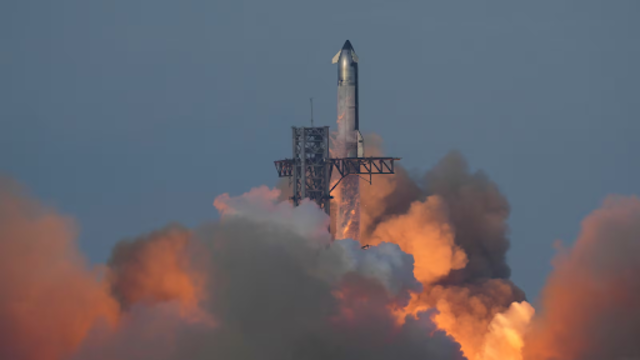
SpaceX’s massive Starship rocket lifted off from its Starbase site in Texas during a test flight on Tuesday, August 26, 2025. AP
SpaceX celebrated a major milestone on Tuesday after its Starship rocket completed a one-hour test flight. The launch took place in Texas just after 6:30 p.m. local time. The rocket, hailed as the largest and most powerful ever built, managed to complete its mission despite dramatic moments mid-flight.
The success marked a turning point after three failed attempts earlier this year, including one that ended with an explosion on the launch pad in June.
SpaceX founder Elon Musk expressed his excitement online, writing, “Great work by the SpaceX team!!”
Details of the Flight
All 33 engines of the Super Heavy booster ignited at liftoff. Roughly seven minutes later, the booster separated from the spacecraft and dropped into the Gulf of Mexico.
The Starship spacecraft then climbed nearly 200 kilometres above Earth, before circling the planet. Cameras captured sparks and flames as flaps on the rocket’s sides caught fire and shifted violently, but the rocket held together long enough to complete its mission.
SpaceX admitted it pushed Starship to its limits on purpose to test durability under extreme conditions.
Why Starship Matters
Starship is not only SpaceX’s boldest project but also central to NASA’s future. The American space agency has chosen a modified version of Starship to take astronauts to the Moon as part of its Artemis program in 2027.
Many experts doubt that timeline, but Tuesday’s success brought renewed optimism. Musk has said he hopes to see Starship certified for human space travel as early as next year. He has also floated plans for uncrewed missions to Mars within the next 12 months.
Learning from Failure
Unlike most aerospace firms, SpaceX embraces failure as part of its design process. Explosions and setbacks are viewed as opportunities to collect valuable data. Still, critics questioned the company’s direction after repeated Starship failures this year.
Earlier tests saw debris scatter across the Caribbean, and June’s launch pad explosion raised safety concerns. Some observers also suggested Musk’s involvement in U.S. politics distracted from the company’s focus.
Tuesday’s test helped quiet those doubts.
Looking Ahead
Starship has a long way to go before carrying astronauts, but the latest flight marked real progress. NASA’s schedule remains tight, and the company must prove the rocket can fly safely and consistently.
For Musk and SpaceX, however, the mission showed clear momentum. A spacecraft once seen as a series of fiery failures has now taken a giant leap closer to its goal: carrying humans to the Moon and, one day, Mars.