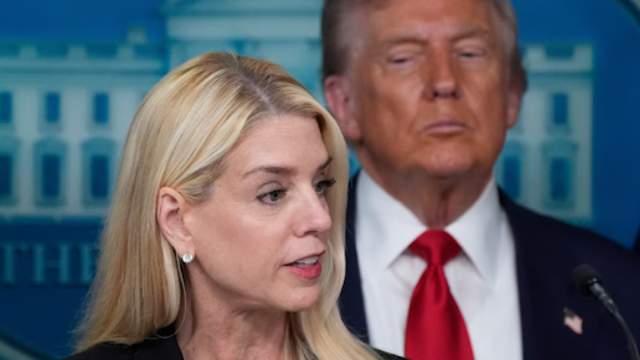
Former Attorney General Pam Bondi speaks with reporters in the James Brady Press Briefing Room at the White House on Monday, Aug. 11, 2025, in Washington, while President Donald Trump listens nearby. (AP Photo)
Canadian and U.S. officials met in Washington on Wednesday to discuss border security and fentanyl trafficking. The meeting started on a solemn note as U.S. Attorney General Pam Bondi had just attended a White House briefing about a tragic Minnesota school shooting that left two children dead. Canadian officials expressed their condolences before turning to the main agenda.
Focus on border and fentanyl
A senior Canadian government source described the meeting as “very warm, very cordial and very hospitable.” The U.S. Department of Justice requested the meeting, which Canadian officials framed as a chance to keep an open dialogue with their American counterparts.
Justice Minister Sean Fraser, Public Safety Minister Gary Anandasangaree, and fentanyl czar Kevin Brosseau represented Canada. Both sides spoke about fentanyl trafficking, border enforcement, and broader security cooperation.
Strained history over fentanyl
Fentanyl has been a sticking point between the two governments for months. U.S. President Donald Trump has often pointed to fentanyl as a reason for tariffs against Canada. He also declared a national emergency, citing a public health crisis worsened by the flow of the drug into the U.S.
Canada has since appointed a fentanyl czar and committed $1.3 billion to strengthen border surveillance and enforcement. While most fentanyl entering the U.S. comes from Mexico, a recent American think tank study showed large seizures at the Canadian border remain uncommon.
Still, the White House previously accused Canada of failing to cooperate in addressing the issue. In a July statement, U.S. officials said Canada had not done enough to stop the flow of fentanyl and other drugs across the border.
Broader issues on the table
Beyond fentanyl and border security, Canadian officials also outlined upcoming legislation. They shared plans for fall bills addressing bail and sentencing reforms, gender-based and hate crimes, and stronger victim support.
The U.S. acknowledged Canada’s recent efforts, with the Canadian source noting the Americans “acknowledged the work that Canada is doing at the border.”
Optimism on trade talks
The border meeting followed trade discussions between Canada’s minister for U.S. relations, Dominic LeBlanc, and U.S. Commerce Secretary Howard Lutnick a day earlier. According to a senior Canadian source, LeBlanc left those talks with optimism and a sense of progress.
Canada’s ambassador to the U.S., Kristen Hillman, will continue trade negotiations while LeBlanc and Lutnick maintain contact from their respective capitals.
Expert views
Peter Clark, an international trade expert, said ahead of the meeting that Canada had managed the relationship carefully. He praised the government’s move to ease some retaliatory tariffs against the U.S., calling it a “good move.” He also credited Ambassador Hillman and her team for guiding the government with solid advice.