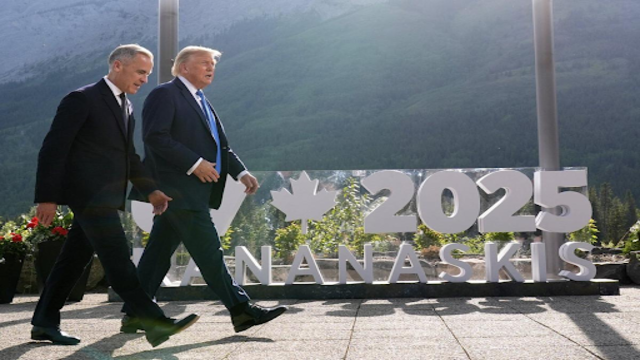
Canada's Prime Minister Mark Carney walks with President Donald Trump after a group photo at the G7 Summit, Monday, June 16, 2025, in Kananaskis, Canada. The Canadian Press
Some Indigenous entrepreneurs in Canada are suspending exports to the United States, citing the impact of new tariff measures introduced by President Donald Trump’s administration. The decision marks a setback for small businesses that have long relied on historic cross-border trade routes predating both nations.
Matthew Foss, vice president of research and public policy at the Canadian Council for Indigenous Businesses, says urgent action is needed. “There must be a resolution that allows Indigenous Peoples to maintain traditional trade routes,” he noted, urging both governments to uphold long-standing agreements.
New Rules Create Barriers
Last month, Trump announced the suspension of duty-free de minimis imports from all countries. The rules, which took effect on August 23, are part of a broader push to boost domestic business.
Under the policy, purchases valued under $800 — once exempt from customs — now require clearance and tariffs ranging from 10 to 50 per cent. For six months, carriers using the global mail network can instead opt for flat duties between $80 and $200 per package.
Foss explained that Indigenous craftworks are technically exempt under the Canada-U.S.-Mexico trade deal. Yet the paperwork needed to claim that exemption is overwhelming for many small operators. “We’re pushing the federal government to act, but it’s moving too slowly,” he said.
Businesses Forced to Pause Sales
For some Indigenous artisans, the changes have been devastating. Stevi Riley, who runs The Beaded Hero from Walpole Island First Nation, said about half her orders come from U.S. customers. She has now halted all American sales.
“I just felt discouraged,” Riley admitted. “Costs could rise by 35 per cent. I don’t want shipments destroyed or returned.”
Others have made similar choices. Tribal Spirit Drums and Music in Quebec stopped sales south of the border on August 27, as did Cedarlilie Beads, run by Dominique O’Bonsawin.
“This means less reach,” O’Bonsawin said. “The U.S. market is a huge opportunity. Losing it hurts growth and weakens ties with our relatives across the border.”
U.S. Justifies Restrictions
The Trump administration argues that the duty-free exemption has become a loophole exploited by foreign firms and criminals smuggling drugs and counterfeit goods. The issue has drawn attention from U.S. lawmakers, including former president Joe Biden.
But critics say the measures create instability. Jack Royal, chair of the Indigenous Businesses Corporation, said uncertainty is harming both Indigenous and Canadian companies. “Like other small businesses, First Nations want stability and support to explore other options,” he explained.
Wider Trade Concerns
The Universal Postal Union reported that 25 countries have suspended postal services to the U.S. until further clarity emerges. While Canada Post has not stopped exports, it has warned business owners it is assessing options to safeguard continuity.
Foss confirmed that the Canadian Council for Indigenous Businesses is working with trade officials on solutions. He urged Indigenous leaders to press for restoration of rights tied to historic agreements.
At the Assembly of First Nations meeting in Winnipeg, chiefs are debating resolutions on trade. One proposal calls for legal review of treaty rights to cross-border commerce and demands federal inclusion of First Nations in all tariff negotiations.
Hope for Resolution
Despite the setbacks, many business owners remain hopeful. O’Bonsawin expressed optimism that future U.S. administrations may restore smoother trade. “I don’t expect quick change,” she admitted, “but I’m hopeful things will eventually return to normal.”