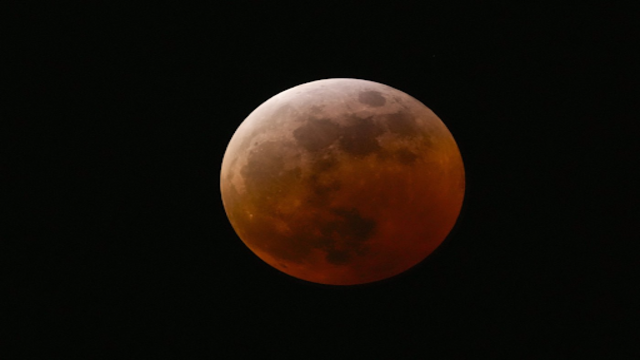
Skies Over Asia to Glow Red in Weekend Lunar Eclipse. Image of the moon during a total lunar eclipse, in Mexico City, Friday, March 14, 2025. (AP Photo)
A breathtaking celestial display is on the horizon this weekend, and Asia will have the best view. The year’s second total lunar eclipse will turn the full moon into a striking red orb, giving millions across the continent front-row seats to a rare spectacle.
As Earth positions itself directly between the sun and the moon, its shadow will completely obscure the lunar surface. The total eclipse, known as a “blood moon” for its glowing crimson hue, will last an impressive one hour and 22 minutes. Including the partial stages, the entire event will stretch for more than five hours.
A Global Show, with Asia at the Center
Unlike March’s eclipse, which favoured the Americas, this weekend’s phenomenon unfolds over the opposite side of the world. The full eclipse will be visible across Asia, from Saudi Arabia to the Philippines, reaching as far north as the Arctic Ocean and as far south as Antarctica.
Observers in East Africa and western Australia will also witness the complete event. Other regions, including the rest of Africa, Europe, and eastern Australia, will see only parts of the spectacle. On the fringes, small glimpses will even be visible from Alaska and Brazil’s eastern coast.
The Science Behind the Red Glow
The blood-red appearance is caused by sunlight scattering through Earth’s atmosphere. While shorter wavelengths like blue and green are filtered out, longer red wavelengths bend around the planet and cast an eerie glow onto the moon. This natural prism effect transforms the familiar white moon into a dramatic crimson disc.
Astronomers often note that each eclipse is unique, influenced by atmospheric conditions such as dust, clouds, and volcanic ash. This weekend’s moon may appear deep red, coppery, or even tinged with orange, depending on local skies.
Timing and Duration
The eclipse begins with the moon slowly slipping into Earth’s penumbral shadow, creating a subtle darkening. As the night progresses, a visible “bite” will be taken out of the moon before it is fully enveloped. Totality, lasting nearly 82 minutes, offers the most dramatic phase, before the process reverses.
For many across Asia, the full spectacle unfolds Sunday night into the early hours of Monday. Local times will vary, but observers are advised to check precise schedules for their regions to catch the entire sequence.
What Comes Next
This lunar eclipse will be followed by another celestial event just two weeks later. A partial solar eclipse is expected, with visibility limited to parts of New Zealand, a narrow slice of Australia, and Antarctica. Together, these back-to-back alignments make for an exciting period for skywatchers.
A Rare Opportunity
For much of Asia, this weekend’s eclipse is not just another astronomical occurrence. With total visibility spanning such a wide region, it is a chance for millions to look skyward and witness a cosmic alignment that won’t happen in the same way again soon.
As the Earth’s shadow drapes across the moon, night skies across Asia will transform into a natural theatre. For those fortunate enough to experience totality, the blood moon promises a reminder of the universe’s quiet but powerful beauty.