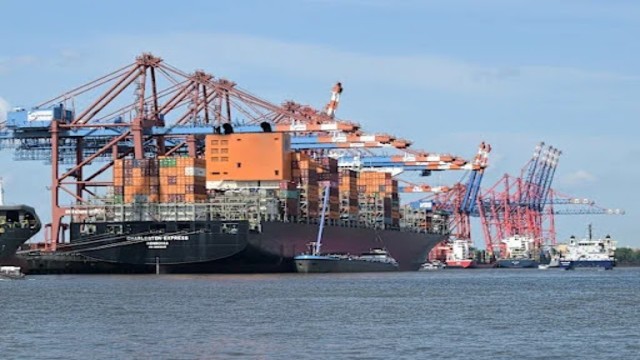
Container ships docked at Hamburg’s harbour terminal in northern Germany. Together, the EU and U.K. form a market of 519 million people—bigger than North America. (Getty images)
Canadian exporters are not making full use of Europe’s vast market, despite tariff-free access under a major trade deal. A new report highlights how Canada is leaving money on the table while its European partners reap more benefits.
Canada’s heavy reliance on the U.S. market has become increasingly risky, given Washington’s unpredictable trade moves and the looming review of CUSMA. Economists warn that Canada must diversify to protect its long-term economic security.
“Canada should have made this pivot much earlier,” the report’s author noted. “Opportunities are there—we just need to act.”
Europe as the Natural Alternative
The European Union and the United Kingdom together represent 519 million consumers—more than North America’s population. They also offer a stable regulatory environment and growing political alignment with Canada.
Prime Minister Mark Carney underlined this connection by making Europe his first official overseas visit. NATO and EU commitments to higher defence spending are strengthening ties further.
Against this backdrop, Europe looks like Canada’s best bet for reducing dependence on its southern neighbour.
Why CETA Isn’t Working for Canada
The Comprehensive Economic and Trade Agreement (CETA) between Canada and Europe was designed to unlock new markets. But many Canadian companies aren’t using it.
In 2021, one-third of eligible Canadian exports to the EU skipped preferential treatment, forfeiting tariff-free access. Key sectors like machinery, auto parts, and electrical equipment have some of the lowest utilization rates.
Europe, by contrast, has embraced the deal. Since 2017, EU nations, including Germany, have boosted their trade balance with Canada. Canada’s goods deficit with Europe has widened, with only limited gains in energy, mining, and some farm products.
Sectors Where Canada Could Shine
Despite missed chances, several areas offer huge promise:
Critical minerals and metals – Canada’s nickel and other minerals could help Europe reduce dependence on China.
Green energy– The EU’s push for renewable energy creates demand for Canadian hydrogen and clean power technology.
Digital services and AI – Europe’s need for digital sovereignty aligns with Canadian expertise in IT, AI, and cybersecurity.
Healthcare and biotech – An ageing European population opens the door for Canadian medical innovations.
Public procurement – CETA grants Canadian firms access to Europe’s \$2 trillion public contract market.
The Roadblocks Ahead
Cracking into Europe will not be fast or simple. Companies may spend years adjusting to European standards, certifications, and market expectations. For instance, Canadian lumber exporters must shift from imperial to metric measurements.
Geography also adds costs. Shipping across the Atlantic is pricier than trucking goods to the U.S. Yet transatlantic shipping has proven more stable than other global routes, reducing one source of uncertainty.
A Long-Term Trade Shift
The report stresses that building a strong European foothold should not be seen as a short-term hedge against U.S. trade risks. Instead, it should be viewed as a long-term strategy to reshape Canada’s trade future.
“The payoff from diversification will unfold over a decade or more,” the report concluded.
If Canada embraces this shift, it could finally unlock the full potential of Europe’s vast marketplace—and avoid the cost of putting all its eggs in one American basket.