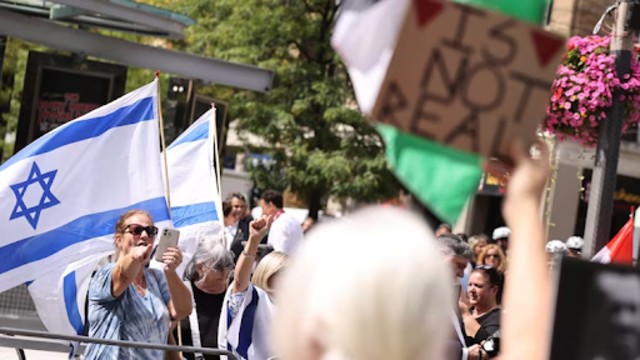
Protesters outside Roy Thomson Hall during TIFF 2025 screening of The Road Between Us: The Ultimate Rescue
The Toronto International Film Festival (TIFF) turned into a charged arena this week as a controversial documentary on the 2023 Hamas attacks made its world premiere. While the film sparked emotional responses inside the theatre, the streets outside filled with protests, chants, and heavy police presence.
Divided Streets, Tight Security
Outside Roy Thomson Hall, two opposing groups lined Simcoe Street. One waved Israeli flags, the other Palestinian banners. They chanted, argued across barricades, and held signs that reflected their pain and anger.
Despite heated exchanges, the scene remained mostly controlled, though one man was arrested for assault. Mounted police, officers on foot, and security teams guarded both the hall and its entrances. Attendees passed through metal detectors, bag checks, and pat-downs before stepping inside.
The Film That Sparked It All
The documentary, The Road Between Us: The Ultimate Rescue, directed by Canadian filmmaker Barry Avrich, follows retired Israeli general Noam Tibon. It tells the story of how he risked his life to save his family during the Hamas attack on October 7, 2023.
For some, the film highlights bravery during a horrifying day. For others, its focus ignores the broader and decades-long conflict.
Voices from the Protest
Pro-Palestinian demonstrators argued that screening the film while civilians in Gaza face deadly bombardments is insensitive.
“This is wildly inappropriate,” one protester said. “We don’t need more films humanizing the Israeli side. Palestinians need that recognition after years of suffering.”
Another organizer pointed out that focusing on October 7 alone risks erasing the history of occupation and violence in the region. “This didn’t begin last year. To tell the story properly, you need the full picture,” he said.
Support for the Film
Not everyone outside opposed the screening. Some attendees argued that October 7 marked the trigger point for the ongoing war. “That’s the event that started it all,” one viewer said. “The story needs to be told.”
Avrich himself has stressed that film festivals should give space to all sides. He believes part of a festival’s role is to show works that make audiences uncomfortable and spark debate.
From Cancellation to Applause
The road to the premiere was rocky. In August, TIFF pulled the film citing safety and legal concerns. The decision drew international backlash, especially from Jewish arts groups. Days later, festival organizers reversed course and reinstated the film.
Avrich admitted the initial cancellation was painful but said he was relieved when TIFF agreed to show it. On opening night, he thanked his collaborators and TIFF leadership before receiving a standing ovation from the packed hall.
Inside the Theatre
The atmosphere inside was celebratory but not free of tension. During a post-screening Q&A, questions about the rising death toll in Gaza drew boos from parts of the audience. Avrich urged the crowd to let the panel respond, highlighting once again the deep divisions surrounding the conflict.
Protests at TIFF are not new
TIFF has witnessed protests before. Only last year, screenings of a documentary on Russia’s invasion of Ukraine stirred similar outrage and demonstrations.
This year, alongside Avrich’s film, the festival is also screening two Palestinian-focused works: The Voice of Hind Rajab and Palestine 36. Their inclusion adds further layers to a festival determined to showcase multiple perspectives—no matter how difficult the conversations may be.