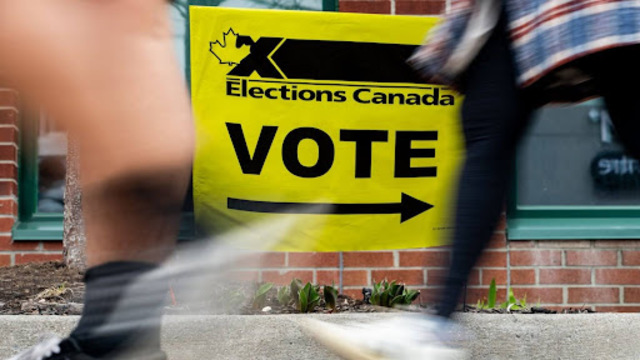
Elections Canada signs mark an advance polling station in Ottawa on April 18, 2025. The Canadian Press
Canada’s 45th federal election in April saw Liberals under Mark Carney win a near majority, costing slightly less than the previous vote. Elections Canada reports the April 28 election cost $570 million, down from $574.2 million in 2021. Currently, Liberals hold 169 seats, Conservatives 144, Bloc 22, NDP seven, and Greens one. Legal challenges in Quebec could still change totals.
A major shift in this election was early voting. Of 19.8 million Canadians who cast ballots—69% of registered voters—8.7 million (44%) voted before election day, setting a new record. Stephane Perrault, Canada’s chief electoral officer, said, “Candidates want their known supporters to lock in their vote early. The campaigns are inciting voters to go in and vote so they can focus on the undecided electorate.”
This trend creates pressure on Elections Canada to increase resources for advance polling, especially during snap elections with short timelines. Perrault explained, “In a non-fixed date election context for a short election period of 36 days, our system may have reached its limit.” He added that extending the minimum election period could help reduce errors.
Mail-in Ballots and Challenges
The report also highlights mail-in voting. Only 140,885 voters used mail ballots, far fewer than the 2021 pandemic election, which saw over half a million. However, mail errors caused issues in Terrebonne, Quebec, where the Liberal candidate won by just one vote after two recounts. Mislabelled ballots and incorrect postal codes led to five late ballots and 16 undelivered. This result is being legally contested and will be heard in Quebec Superior Court on October 20.
Large Candidate Ballots
Elections Canada also managed unusually large candidate lists. In Carleton, Ontario, with 91 candidates, the counting of advance votes began six hours before polls closed. During the Battle River—Crowfoot by-election in August, over 200 candidates competed. To handle the long list, voters wrote their choice while consulting a printed candidate list—a practice that may continue in future elections with large ballots.
Security Incidents
Elections Canada recorded 44 security incidents during the election, 29 requiring police. Three involved physical assault, three criminal activity, and 23 were disruptive or threatening behaviors, including confrontations over voter ID or tampering.
Looking Ahead
The report indicates Canada is seeing lasting changes in voter behaviour, especially with more people voting early. Elections Canada must adapt to maintain efficiency, accuracy, and security. Longer election periods, additional advance polling sites, and innovative ballot handling may be key to meeting these new challenges.