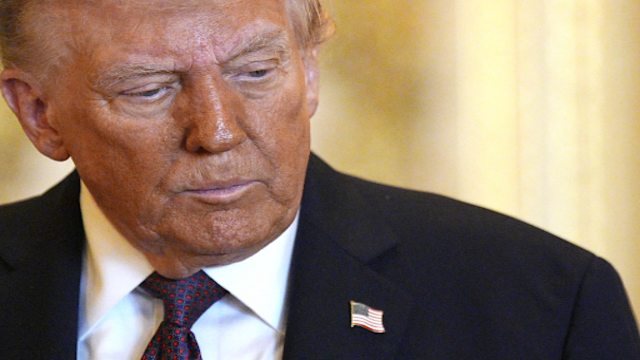
President Donald Trump pictured in Windsor, England, on Wednesday. (Getty Images)
President Donald Trump announced early Thursday morning UK time on his Truth Social platform that he is designating the far-left anti-fascist movement Antifa as a terrorist organization. He wrote, “I am pleased to inform our many U.S.A. Patriots that I am designating ANTIFA, A SICK, DANGEROUS, RADICAL LEFT DISASTER, AS A MAJOR TERRORIST ORGANIZATION.”
Trump added he would “strongly recommend” investigations into anyone funding Antifa, “in accordance with the highest legal standards and practices.” A White House official described the move as “just one of many actions the president will take to address left wing organizations that fuel political violence.”
Background and Context
Trump’s announcement comes while he is overseas on a formal state visit. He had previously signaled such a move earlier this week in remarks following the murder of conservative activist Charlie Kirk. Administration officials said they aim to target what they view as coordinated left-wing efforts to incite violence.
However, the designation raises questions because Antifa is not a structured organization. It lacks centralized leadership or a formal hierarchy, making it unclear who or what would be targeted. Past attempts to label Antifa as a terrorist organization faced legal challenges for similar reasons.
Challenges in Enforcement
Unlike foreign terrorist groups, U.S. law does not provide a clear mechanism to criminally prosecute domestic movements like Antifa. While providing “material support” to foreign terrorist groups is illegal, no equivalent law exists for domestic groups. Antifa is a loose network of activists with far-left views, often operating in local cells or independent groups without formal membership.
Trump’s move is part of a wider strategy against left-leaning organizations. Earlier this week, he suggested revoking tax-exempt status for liberal non-profits. He also discussed with Attorney General Pam Bondi the possibility of pursuing racketeering (RICO) cases against groups he claims fund left-wing agitators.
Political Reactions
The announcement has stirred debate in Washington. Some Democrats argue Trump’s designation is a pretext to suppress dissent and target political opponents. Republicans are divided, with some supporting measures to confront left-wing extremism and others questioning the practical effects of the move.
Trump stated, “Antifa is terrible. There are other groups. We have some pretty radical groups, and they got away with murder,” though he provided no evidence to support the claim. He added that any groups targeting conservatives should face criminal charges and jail time.
Looking Ahead
It remains uncertain how the designation will affect Antifa in practice. Legal experts note that without clear leadership or funding structures, enforcement may be limited. Nonetheless, Trump’s announcement signals a strong political stance against far-left movements as the U.S. heads into a tense election period.