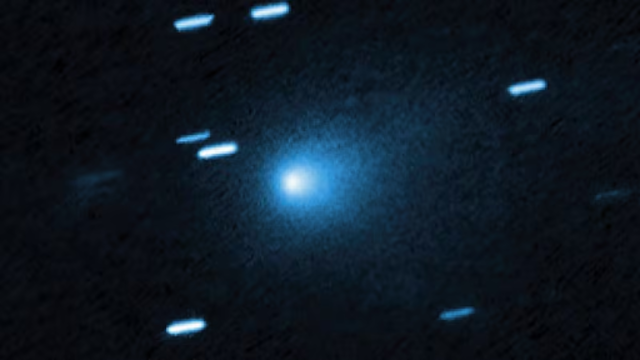
The Hubble Space Telescope took this photo of comet 3I/ATLAS from 445,787 km away on July 25. Photo: Hubble Space Telescope / NASA
Scientists have discovered a comet passing through our solar system with a surprising mix of chemicals. This discovery could help researchers better understand how planets and stars form in other parts of the galaxy.
A Rare Visitor
The comet, called 3I/ATLAS, is only the third confirmed object from outside our solar system. It was first spotted in July by a telescope funded by NASA in Chile. The two other objects seen before were ʻOumuamua in 2017 and 2I/Borisov in 2019.
Thanks to the Hubble and James Webb Space Telescopes, astronomers have studied 3I/ATLAS’s makeup in more detail than previous interstellar objects.
Strange Chemical Mix
Dr. Richard Leveille, a planetary scientist from McGill University in Canada, explained the comet’s chemical makeup differs from comets in our solar system.
“For example, it appears to have abundant nickel, but not much iron,” Dr. Leveille said. “These two elements are often found together in rocky planets or meteorites.”
Another surprise is the comet contains a lot more carbon dioxide than water. This contrasts with comets in our solar system, which usually have more water than carbon dioxide.
Scientists do not yet know what these differences mean. Dr. Leveille suggests the comet may come from a star system very different from ours.
Why Study Comets?
Dr. Dimitra Atri from New York University Abu Dhabi said studying comets is important because they can tell us about the early solar system.
“Comets and asteroids hold clues to early processes erased on Earth by weather and tectonic activity,” Dr. Atri said. “They contain materials that likely brought water and organic molecules to Earth.”
By studying these objects, scientists hope to better understand early Earth and even predict future climate changes.
What the Comet Can Teach Us
The chance to study an interstellar comet like 3I/ATLAS is rare. Dr. Leveille believes learning more about its makeup can help compare our solar system to others in the galaxy.
He said, “Studies of this comet and others like it will show us the variety of planetary systems and conditions beyond our solar system.”
Exoplanets, or planets around other stars, often exist in systems very different from ours. Some even orbit two or more stars, unlike our single Sun. These differences mean conditions on those planets can be very unusual.
Finding More Interstellar Objects
Dr. Leveille added that improved technology and a bit of luck have helped spot these distant visitors. New observatories, such as the Vera Rubin Observatory, may find several interstellar objects every year.
“The more we find and study, the better we understand the origins and changes in our solar system,” he said. “It also helps us learn about the many different planetary systems across our galaxy.”