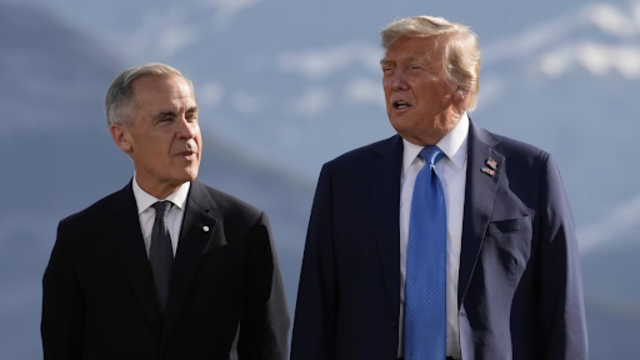
Prime Minister Mark Carney listens while U.S. President Donald Trump speaks during a group photo session at the G7 Summit in Kananaskis, Alberta, on Monday, June 16, 2025. CTV
Prime Minister Mark Carney will travel to Washington on Tuesday to meet with U.S. President Donald Trump, hoping to secure relief for Canada’s steel and aluminum sectors. According to a government source, the meeting could be key to easing the growing pressure on Canadian industries facing high tariffs.
This will be Carney’s second visit to Washington since his election in April. During his time in office, U.S. tariffs on steel, aluminum, and lumber have climbed sharply, creating financial strain for Canadian producers.
Weighing Political Risk and Reward
Carney’s trip carries political risk, but analysts say it’s necessary.
“From his point of view, it’s better to take the risk of political failure and go to Washington and meet with President Trump rather than sit in Ottawa and hope that something comes to him,” said Eric Miller, president of Rideau Potomac Strategy Group.
Carney has tried to maintain a working relationship with Trump, describing him as a “modern man.” He also told Parliament that they “speak regularly” and “send each other text messages.”
Former White House adviser Kelly Ann Shaw said leaders who build personal connections with Trump often fare better in negotiations. Still, she warned that this meeting could prove difficult. “For Canada to see reductions in steel and aluminum tariffs, a much broader deal will need to be struck,” she said.
Trade and Security at the Table
Experts believe any progress on tariffs will involve more than trade discussions. Shaw noted that the talks could also touch on national security and broader North American trade issues, possibly laying the groundwork for future CUSMA (USMCA) reviews.
While there is some Liberal optimism about reaching tariff relief, most political observers remain cautious. Miller explained that the U.S. sees little incentive to change the current arrangement. “The status quo is working for them,” he said. “They’re collecting tariffs on politically sensitive products while keeping the North American market largely open.”
The Aluminum Association of Canada also expressed doubt that an immediate agreement would emerge but said finding a resolution before the next CUSMA review is essential.
Domestic Pressure Mounts
At home, Carney faces mounting pressure to deliver results. Polls suggest Canadians recognize the difficulty of negotiating with Trump but expect progress.
Conservative Leader Pierre Poilievre has focused his criticism on domestic affordability and investment concerns tied to tariffs rather than Carney’s approach to Washington.
Political analyst David McLaughlin, former chief of staff to Prime Minister Brian Mulroney, said the outcome of this meeting could define Carney’s leadership. “This is for the Prime Minister to deliver or fail,” he said. “If he fails, it becomes a very heavy anchor that will drag him down.”
Still, McLaughlin believes that Carney’s visit is the right move, even if no immediate breakthrough comes. “He has to find that balance between standing firm and being diplomatic,” he said. “The Oval Office is a tough place to do that, but he really has no choice.”