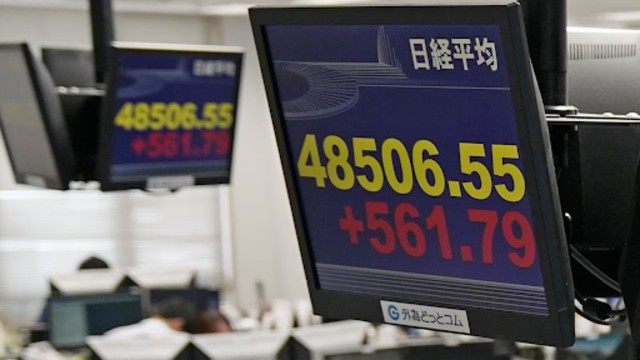
Electronic stock boards show Japan's Nikkei 225 index at a foreign exchange firm in Tokyo, Tuesday, Oct. 7, 2025. (Kyodo News via AP)
Global stock markets showed a mixed performance on Wednesday following a retreat in U.S. equities, while gold surged to record levels. Investors are navigating uncertainty, balancing hopes for economic growth against inflationary pressures and geopolitical shifts.
U.S. stocks fell for the first time in eight days on Tuesday. The S&P 500 dropped 0.4%, the Dow Jones Industrial Average slipped 0.2%, and the Nasdaq lost 0.7%. Tesla led the declines, falling 4.4% after unveiling cheaper versions of two of its electric vehicle models. Oracle also contributed, declining 2.5% amid reports of thin profit margins in a key AI-related business line.
Despite recent losses, futures for the S&P 500 and Dow were up 0.2% on Wednesday, reflecting cautious optimism that the U.S. economy remains resilient. Investor interest in artificial intelligence continues to support stock prices, though some analysts warn valuations may have risen too high.
Gold Soars Above $4,000
Gold continued its strong rally, trading at $4,062.10 per ounce, up nearly $58. Investors view gold as a safe haven against high inflation and global uncertainty. Its price has risen more than 50% this year amid rising government debts, political tensions, and expectations that the Federal Reserve may cut interest rates.
European Markets Edge Higher
In Europe, shares opened higher, reflecting calmer investor sentiment despite political turbulence. France’s CAC 40 climbed 0.6% to 8,021.50 as outgoing Prime Minister Sébastien Lecornu raced to ease political deadlock caused by his sudden resignation. Germany’s DAX rose 0.3% to 24,455.12, while the FTSE 100 in London also gained 0.3%, closing at 9,513.67.
The U.S. dollar strengthened against both the euro and Japanese yen. The euro slipped to $1.1625 from $1.1659, while the dollar rose to 152.45 yen from 151.90 yen, following political developments in France and Japan.
Asia Shows Mixed Signals
Asian markets saw a varied response. Tokyo’s Nikkei 225 fell 0.5% to 47,734.99, retreating from recent record highs after Sanae Takaichi became the Liberal Democrats’ leader. Takaichi is expected to maintain low interest rates, potentially delaying the Bank of Japan’s efforts to tighten monetary policy. Inflation-adjusted wages in Japan fell for the eighth consecutive month in August.
Elsewhere, Hong Kong’s Hang Seng dropped 0.5% to 26,829.46, while Australia’s S&P/ASX 200 edged down 0.1% to 8,947.60. Taiwan’s Taiex lost 0.5%, and India’s Sensex rose 0.1%. Markets in mainland China and South Korea were closed for holidays.
Oil Prices Rise
Energy markets also saw gains, with U.S. crude oil up 41 cents to $62.14 per barrel. Brent crude rose 38 cents, reaching $65.83 per barrel.
Investors continue to weigh the rapid adoption of AI and its potential economic impact against inflation risks and government debt levels. The coming weeks may reveal whether optimism for AI-driven productivity gains can support markets, or if global uncertainties will dominate investor sentiment.