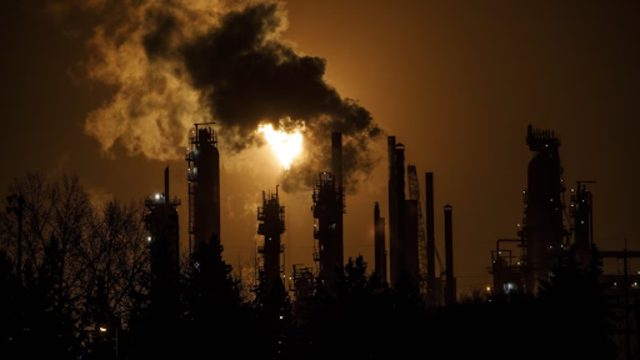
A flare stack brightens the night sky at an Edmonton refinery on December 28, 2018. (THE CANADIAN PRESS)
Global carbon dioxide levels have hit a record high in 2024, raising concerns among scientists and climate experts. The World Meteorological Organization (WMO) released a report showing that CO2 levels are now increasing at a rate three times faster than in the 1960s.
The findings reveal that rising fossil fuel emissions and weakened natural absorbers like forests and oceans are driving this dangerous trend.
Damon Matthews, a climate scientist at Concordia University, says the new data should serve as a “wake-up call” for Canada and the world to act faster on cutting emissions. “We need to cut our emissions in half and keep reducing them toward zero to stabilize the climate,” he said.
Canada Urged to Stay the Course
Matthews, who sits on a federal climate advisory panel, urged Canadian leaders not to bend under international pressure to slow climate initiatives.
He criticized recent comments by U.S. President Donald Trump, who called climate change a “con job” and has withdrawn from key environmental agreements. Trump’s rollback of renewable energy projects and opposition to clean energy, Matthews said, highlight why Canada must stand firm in its climate commitments.
“This is not the time to take our foot off the gas when it comes to climate action,” Matthews said.
Wildfires and El Niño Worsen CO2 Rise
The report attributes 2024’s record CO2 surge partly to massive wildfire emissions and a weakened ability of the land and oceans to absorb carbon. The year was also the hottest ever recorded, intensified by a strong El Niño, a natural climate cycle that boosts global temperatures.
Usually, about half of all CO2 released into the atmosphere is absorbed by trees, soil, and oceans. But scientists warn that these “carbon sinks” are losing strength.
“As the Earth warms, the oceans take in less carbon dioxide, and forests burn or dry out,” the report said. “That means more carbon stays in the air.”
Matthews added that these changes show the world has not yet reached a “new normal.” Instead, he said, “Things are going to keep getting worse until we fix the root of the problem.”
Global Warming Targets in Jeopardy
The WMO’s findings align with a June study co-authored by Matthews and over 60 scientists. That study warned the world is on track to emit enough greenhouse gases in the next three years to exceed the global warming limit of 1.5°C.
United Nations climate chief Simon Stiell has also warned that the Earth is heading toward a 3°C rise, far above safe levels.
With the COP30 climate summit set to take place next month in Brazil, scientists are calling for stronger international commitments and improved greenhouse gas tracking.
“The ability to measure and monitor greenhouse gases is essential for progress,” said Oksana Tarasova, who leads the WMO’s Greenhouse Gas Bulletin program.
Fastest CO2 Growth in Decades
The WMO reported that annual CO2 growth rose from an average of 2.4 parts per million between 2011 and 2020 to 3.5 ppm between 2023 and 2024 — one of the fastest jumps ever recorded.
Data from the U.S. National Oceanic and Atmospheric Administration show that while growth in 2025 is slightly slower, carbon levels remain dangerously high.
Experts say the message is clear: the world is running out of time to curb emissions — and Canada must continue leading by example.