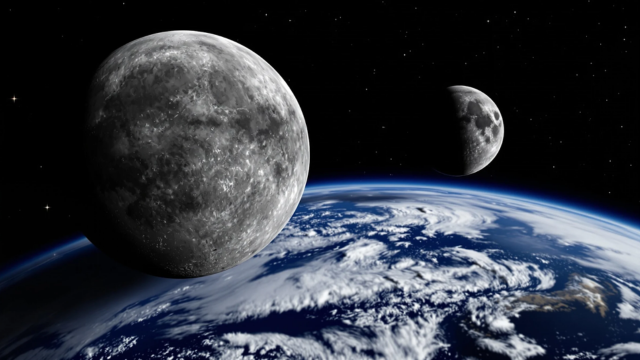
NASA says the asteroid 2025 PN7 has travelled alongside Earth for about 60 years and will continue to follow our planet’s path until 2083. Yahoo!
Earth has gained a new travelling partner in space — a small asteroid named 2025 PN7. NASA confirmed this week that the object, first spotted by astronomers in Hawaii, is officially a “quasi-moon” — a rare kind of space companion that moves almost perfectly in sync with Earth’s orbit around the Sun.
This small visitor doesn’t orbit Earth directly like the Moon does. Instead, it follows a nearly identical path around the Sun, making it seem as if it trails alongside our planet as we both move through space.
Tiny, but Remarkable
Scientists estimate 2025 PN7 measures between 18 and 36 metres wide, roughly the height of a small building. Though small compared to most asteroids, it’s large enough to grab astronomers’ attention.
Unlike the Moon, which is held tightly by Earth’s gravity, this asteroid simply moves near us, staying close without being captured. One scientist compared it to “a runner keeping pace beside you on the same track — close enough to see, but never touching.”
Researchers believe 2025 PN7 has been travelling with Earth for about 60 years and will continue to do so until around 2083, when it’s expected to drift away into open space.
At its nearest point, the asteroid passes about 4 million kilometres from Earth — around ten times farther than the Moon. At its farthest, it stretches out to roughly 17 million kilometres. The Sun’s pull and nearby planets constantly influence its path, causing it to drift slightly in and out over time.
Discovery and Confirmation
The University of Hawaii’s team discovered 2025 PN7 earlier this year during a routine sky survey. They noticed a faint object moving steadily against the stars and realized it was following Earth’s same orbit.
After weeks of careful tracking and calculations, NASA confirmed the discovery — Earth had gained a temporary companion in space.
This marks only the eighth quasi-moon ever confirmed by astronomers. Each discovery helps scientists better understand how gravity affects small objects near our planet and how Earth’s orbit interacts with asteroids.
Why It Matters
Quasi-moons like 2025 PN7 aren’t just fascinating to watch — they also help scientists improve their understanding of near-Earth asteroids. These small bodies can provide valuable information about the forces shaping our solar system.
Because they remain relatively close to Earth, they also make appealing targets for future space missions. Researchers say studying such objects could help test new spacecraft technologies or refine methods for tracking potentially hazardous asteroids.
Though 2025 PN7 will never replace our Moon, it serves as a reminder that Earth’s neighbourhood in space is more active and dynamic than it seems. Quietly circling the Sun, this tiny asteroid keeps pace with our planet — a cosmic companion on our endless journey through space.