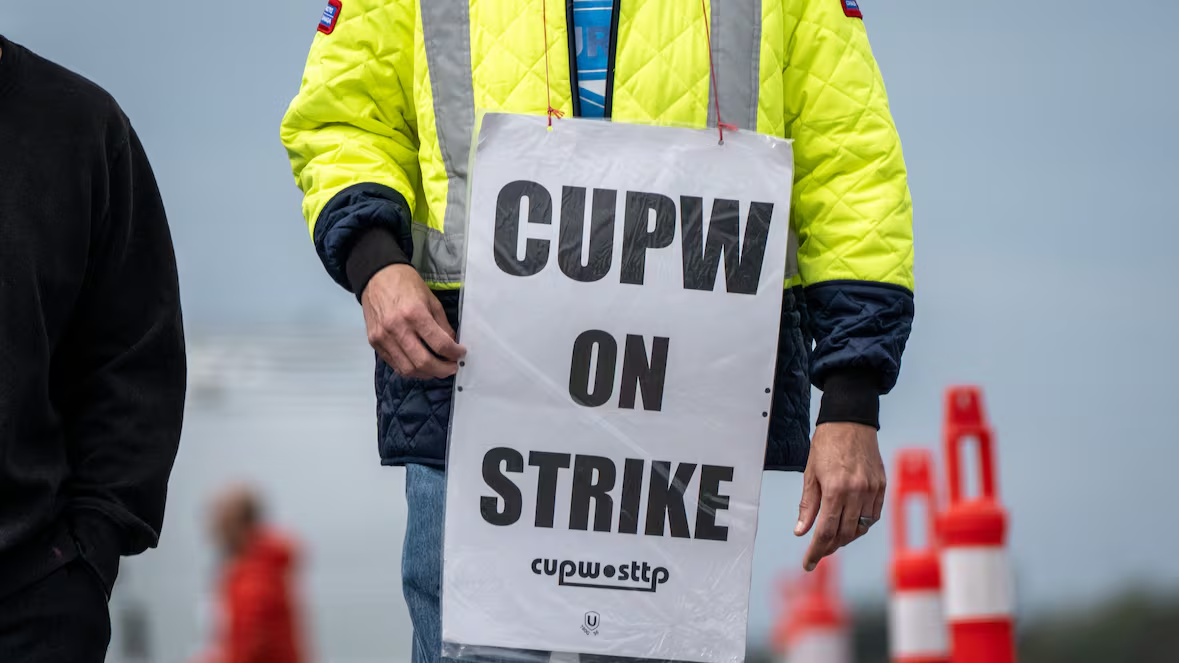
Canada Post employees are seen on the picket line outside the mail processing centre in Richmond, B.C., on September 26, 2025. (CBC)
The Canada Industrial Relations Board (CIRB) has rejected an appeal from the Canadian Union of Postal Workers (CUPW), ruling that the federal government’s decision to end the postal strike through a back-to-work order was constitutional.
The dispute dates back to December 13, 2024, when Labour Minister Steve MacKinnon used his authority under Section 107 of the Canada Labour Code to order an end to the strike and assign arbitration to the CIRB. The move followed weeks of stalled negotiations between Canada Post and its workers.
The union challenged the decision, arguing that forcing employees back to work violated their Charter rights and limited their freedom to strike, which they described as a key part of collective bargaining.
CIRB Says Right to Strike Has Limits
In its decision, the CIRB acknowledged that the right to strike is “essential” in a democratic society but emphasized that it is “not absolute.” The board concluded that the government’s use of Section 107 did not breach the Charter.
It also ruled that the CIRB did not have the authority to review the minister’s decision to suspend the workers’ right to strike. Essentially, the board said the minister acted within the powers granted under federal law.
However, the ruling was not unanimous. One of the three board members, Paul Moist, strongly disagreed with the majority decision.
Dissenting Opinion
In his dissent, Moist accused the government of using Section 107 “as a tool of political expediency.” He argued that the Labour Code was never intended to be used to bypass Parliament or avoid public debate.
“Section 107 was used as reverse engineering of the highest order,” he wrote. Moist also stated that the order unfairly restricted postal workers’ right to strike, which he said undermined their constitutional right to meaningful collective bargaining.
Moist’s opinion echoed the concerns of many labour advocates, who have criticized the government for overusing the measure in recent years.
Union Pursues Further Legal Action
CUPW has since filed for judicial review in federal court, hoping to overturn the CIRB’s decision. As of now, no ruling has been issued.
The CIRB confirmed that it informed both parties of its decision on August 13, releasing it publicly only after official translations were completed.
Debate Over Government Intervention
The use of Section 107 remains a heated topic in Canadian labour circles. Unions argue that it sets a dangerous precedent and weakens workers’ ability to negotiate fair contracts. They claim that frequent government intervention encourages employers to avoid serious bargaining, knowing that Ottawa may eventually step in.
Section 107, introduced in 1984, was originally meant to be used sparingly. However, the Liberal government has invoked it several times in recent years to end strikes at Canada Post, Air Canada, and major railway and port operations in Montreal and Vancouver.
The CUPW’s ongoing legal challenge means the debate over workers’ rights and government power in federal industries is far from over.