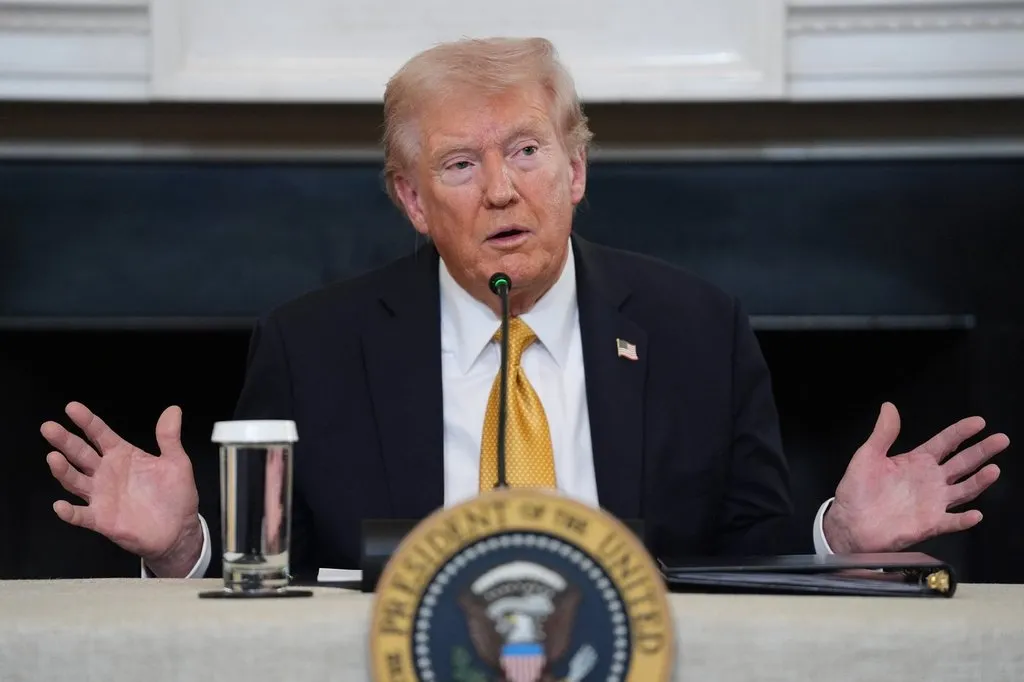
U.S. President Donald Trump speaks to reporters during a roundtable discussion on criminal cartels in the State Dining Room of the White House on October 23, 2025, in Washington. (AP Photo)
Former U.S. President Donald Trump announced late Thursday that he is ending all trade discussions with Canada, citing anger over a television advertisement he called “fake” and “egregious.” The ad, he said, misrepresented his stance on tariffs and was designed to influence U.S. court rulings.
Trump made the declaration in a post on his social media platform, saying, “All trade negotiations with Canada are hereby terminated.” He accused Canada of using a $75,000 advertisement that fraudulently featured Ronald Reagan criticizing tariffs. Trump claimed the ad aimed to interfere with ongoing legal cases in the United States.
“TARIFFS ARE VERY IMPORTANT TO THE NATIONAL SECURITY AND ECONOMY OF THE U.S.A.,” he wrote. “Based on their egregious behaviour, ALL TRADE NEGOTIATIONS WITH CANADA ARE HEREBY TERMINATED.”
Ad at the Centre of the Dispute
The Ronald Reagan Presidential Foundation and Institute confirmed Thursday that the ad, created by the government of Ontario, altered portions of Reagan’s 1987 radio address on trade without permission. The foundation said it was “reviewing legal options” and invited the public to watch Reagan’s original, unedited speech.
The foundation’s statement quickly caught Trump’s attention, prompting his decision to cancel trade talks.
Earlier that same evening, Ontario Premier Doug Ford had promoted the ad on social media, writing, “It’s official: Ontario’s new advertising campaign in the U.S. has launched. We’ll never stop making the case against American tariffs on Canada.”
A spokesperson for Ford did not respond to requests for comment after Trump’s post.
Rising Trade Tensions
The move further strains relations between the two countries, already tense due to Trump’s aggressive tariff policies. In April, Canada introduced retaliatory levies on selected American products while allowing limited exemptions for certain automakers through remission quotas.
Trump’s tariffs have hit Canada’s auto industry particularly hard, especially in Ontario, where car manufacturing is a major employer. Earlier this month, Stellantis announced it would move a production line from Ontario to Illinois due to increasing trade pressure.
The President’s latest remarks came shortly after Prime Minister Mark Carney said Canada plans to double exports to countries outside the U.S. in response to Trump’s trade measures. Carney has been working to reduce Canada’s economic dependence on the American market.
More than 75 per cent of Canadian exports go to the United States, with about $3.6 billion CAD worth of goods and services crossing the border daily.
Political Fallout
Carney’s office declined to comment Thursday night, as he prepared to leave for an Asian trade summit. Trump is also scheduled to attend the same event later this week, increasing the chances of an awkward encounter between the two leaders.
The latest dispute could impact the upcoming review of the U.S.-Mexico-Canada Agreement (USMCA), a trade deal that Trump originally championed during his presidency but has since criticized.
With tensions rising and accusations flying, both sides now face the challenge of preventing a deeper rift in one of the world’s most important trade relationships.