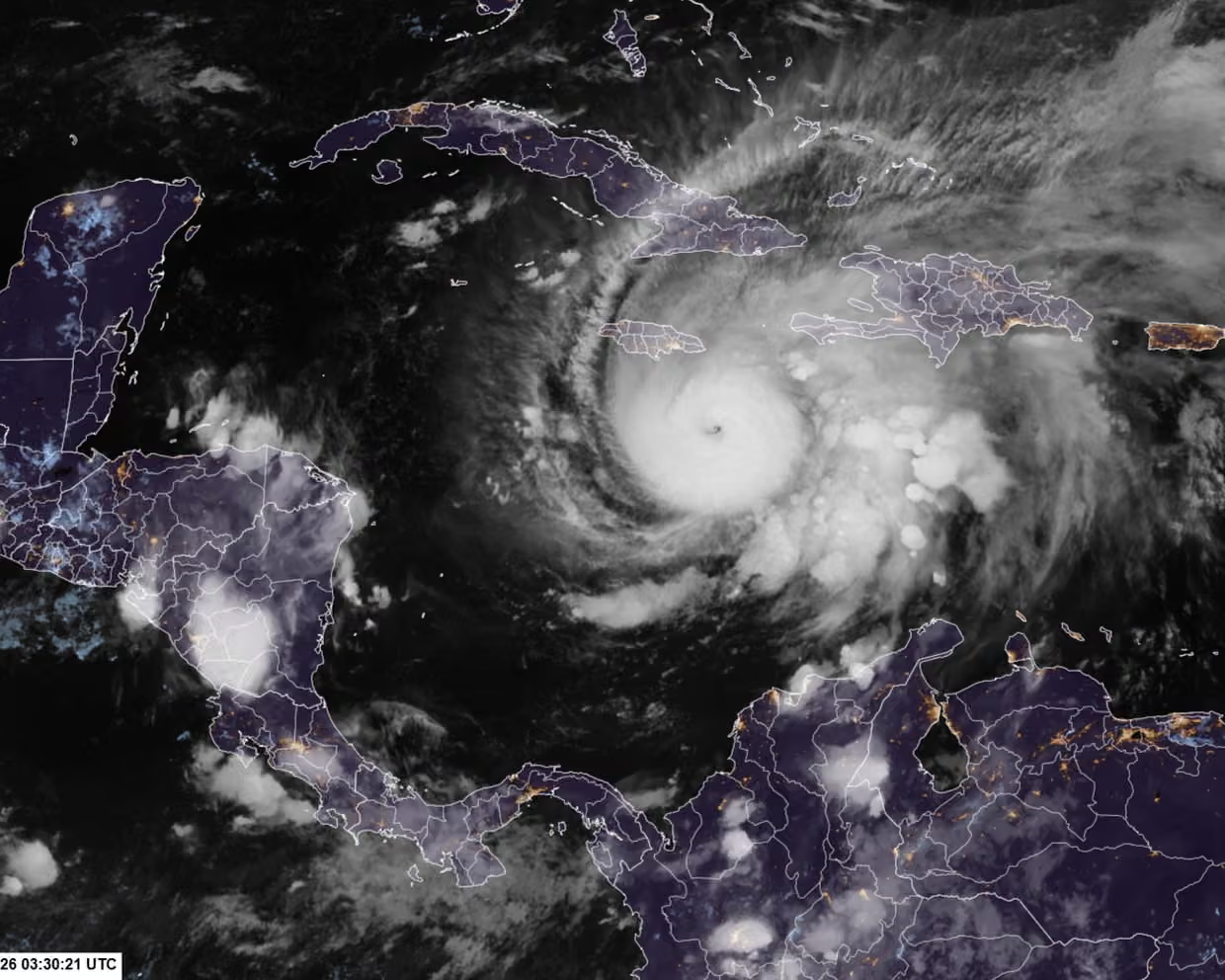
A satellite photo taken Sunday morning shows Hurricane Melissa churning southeast of Jamaica. (Getty Images)
Hurricane Melissa gained strength on Sunday, turning into a fierce Category 4 storm that now threatens to cause major damage across the northern Caribbean. Jamaica faces the greatest risk, with the government ordering mandatory evacuations in several vulnerable areas, including parts of Kingston.
Officials fear the storm could reach Category 5 overnight. Melissa’s winds have already reached 145 mph, and forecasters warn it may strengthen further as it crawls across the Caribbean. By Sunday night, the hurricane’s centre sat roughly 200 kilometres south-southwest of Kingston, moving slowly west at only 7 km/h.
Both of Jamaica’s international airports closed on Sunday, and the government opened 881 shelters across the island. “Many of these communities will not survive the flooding,” warned Desmond McKenzie, Jamaica’s minister of local government. “Kingston is extremely low. No community in Kingston is immune.”
Prime Minister Andrew Holness urged Jamaicans to take immediate action. “Take all measures to protect yourself,” he said. He ordered evacuations for Port Royal and six other coastal and flood-prone areas, including Old Harbour Bay.
Heavy Rain and Rising Danger
Meteorologists expect Melissa to dump up to 30 inches of rain on Jamaica and parts of southern Hispaniola, with some areas facing up to 40 inches. Experts warn that the storm’s slow pace and rapid intensification could create catastrophic flooding and destruction.
The hurricane centre has predicted widespread power and communication outages, major damage to roads and homes, and possible isolation of entire communities. The heavy rainfall could continue for several days, worsening the disaster.
Some Residents Refuse to Leave
Despite official warnings, some residents in Port Royal are choosing to stay put. Ann Marie Chamberlain, 51, said she plans to ride out the storm at home. “Father God will protect us,” she said. Chamberlain explained that past bad experiences in crowded shelters made her hesitant to leave again. “People stole our things last time. We feel safer here,” she added.
Derrick Powell, 42, also decided to stay. “We have been through storms before,” he said. “We know how to prepare.” He described how locals had already pulled boats ashore and secured roofs with metal sheets.
Cuba, Haiti, and the Dominican Republic Brace
Once Melissa moves away from Jamaica, it’s expected to hit Cuba by Tuesday, then head toward the Bahamas by Wednesday. Cuba has already issued hurricane watches for several provinces, including Santiago de Cuba and Guantánamo.
The storm has already caused at least four deaths — three in Haiti and one in the Dominican Republic. In Haiti, rivers have overflowed, bridges have collapsed, and homes have been flooded. In the Dominican Republic, nearly 200 homes were damaged, water systems were disrupted, and more than half a million people lost access to clean water.
Jamie Rhome, deputy director of the U.S. hurricane centre, said, “Unfortunately for places along the projected path of this storm, it is increasingly dire.”
Melissa is the 13th named storm of this year’s Atlantic hurricane season, which runs from June to November. Forecasters expect an above-average season, and Melissa may become one of the most destructive storms yet.