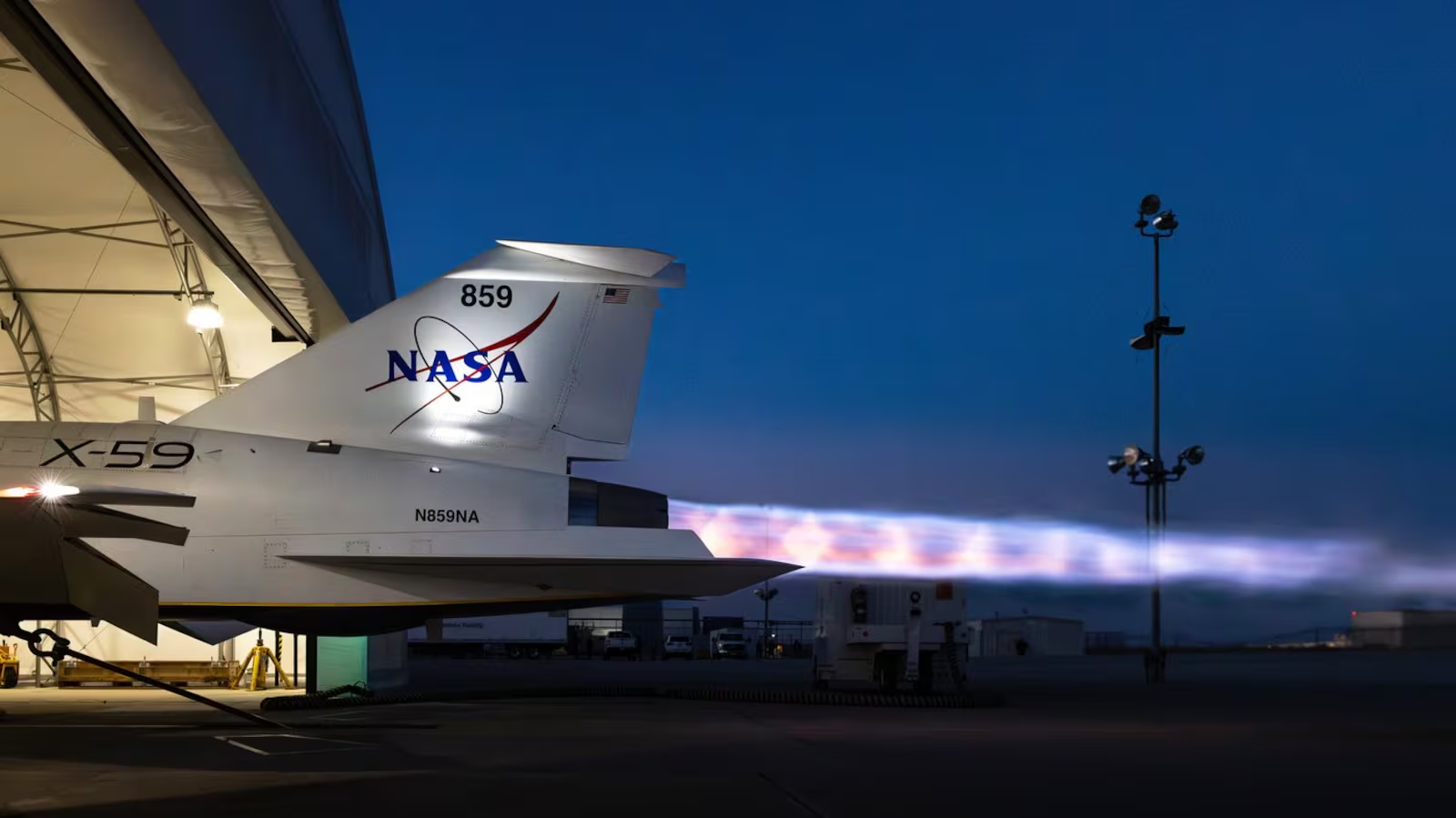
This image, released by Lockheed Martin, shows the X-59 jet developed by NASA and Lockheed Martin in Palmdale, California, on January 1, 2025. The aircraft is designed to fly faster than the speed of sound. AP
NASA has taken a major step toward transforming air travel with the successful first flight of its quiet supersonic jet, designed to reduce the thunderous sound that once made such aircraft unwelcome over populated areas.
Early Tuesday morning, just after sunrise, the sleek X-59 jet lifted off over the southern California desert, marking a new chapter in aviation history. The test flight, conducted in partnership with Lockheed Martin, showed promising results as the plane cruised smoothly from Palmdale to NASA’s Armstrong Flight Research Center, roughly 40 miles away.
NASA said the test was focused on confirming the aircraft’s safety and structure rather than speed. While the jet didn’t break the sound barrier this time, it demonstrated the stability and design needed for future supersonic tests.
Quiet Supersonic Travel
Aircraft capable of flying faster than sound have existed since the 1940s, but loud “sonic booms” — the explosive noise that follows — led to a ban on supersonic flights over land. The challenge for engineers has always been finding a way to maintain speed without the ear-splitting sound.
The X-59, developed under NASA’s Quesst Mission, aims to change that. The plane measures 100 feet long and can fly at supersonic speeds while creating what Lockheed Martin describes as a “gentle thump” rather than a loud boom.
NASA hopes this new design will convince regulators to lift the long-standing ban on supersonic commercial flights, paving the way for a new era of high-speed travel.
The Dream of Faster Flights
If the project succeeds, flights between major cities could become dramatically shorter. A trip from New York to Los Angeles, which now takes about six hours, could be cut nearly in half.
The dream of commercial supersonic travel once became reality with the Concorde, a British-French aircraft that operated from the 1970s until 2003. The Concorde could cross the Atlantic in just three and a half hours but was eventually retired after a deadly crash in 2000 and declining demand due to high costs and noise restrictions.
NASA believes the X-59 could succeed where the Concorde failed — by offering speed, safety, and silence in one package.
Building on Decades of Progress
The world’s first supersonic flight happened in 1947, when U.S. pilot Chuck Yeager broke the sound barrier. Since then, technology has advanced significantly, but the challenge of controlling noise has held back widespread commercial use.
Now, after years of research, NASA and Lockheed Martin are close to proving that quiet supersonic travel is possible. If future tests go well, they plan to fly the X-59 over several U.S. communities to study public reactions to its reduced noise level.
The results could help shape new aviation rules and bring commercial supersonic flights back to the skies — only this time, without the boom.