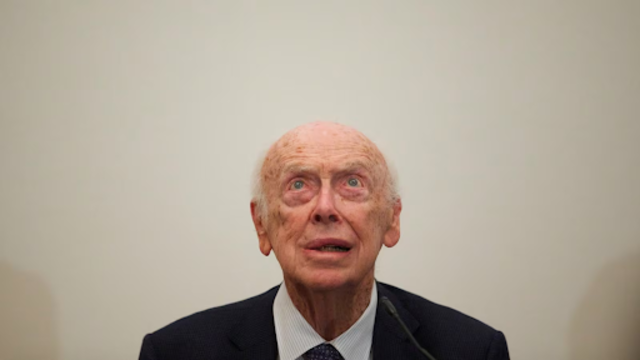
American Nobel Prize winner and biologist James Watson speaks at the Russian Academy of Sciences in Moscow on Wednesday, June 17, 2015. (AP)
James D. Watson, who helped uncover the structure of DNA in 1953, has died at the age of 97. His discovery changed the world of medicine, science, and genetics. Watson’s son said he passed away in hospice care after a short illness. His former research lab confirmed his death the next day.
Watson’s discovery, made when he was only 24, revealed the double helix structure of DNA — two strands twisted together like a spiral ladder. He shared the 1962 Nobel Prize with Francis Crick and Maurice Wilkins for this finding, which became one of the most important scientific achievements of the 20th century.
The Discovery That Changed the World
The double helix model showed how genetic information is stored and copied when cells divide. It became a symbol of modern science and appeared everywhere, from art to stamps. The discovery paved the way for genetic engineering, disease treatment, crime investigations, and ancestry tracing.
Watson once said, “Francis Crick and I made the discovery of the century.” He later wrote that they never imagined how deeply their finding would affect science and society.
A Controversial Legacy
Although Watson’s early career brought him fame, his later years were marked by controversy. He faced public backlash for remarks suggesting that Black people were less intelligent than white people. After his comments in 2007, he was suspended and soon retired from his longtime position at a leading research lab.
In 2019, when asked if his views had changed, Watson replied, “No, not at all.” His statement led the lab to revoke all his honorary titles. Many scientists, including Dr. Francis Collins, criticized him for making “deeply hurtful” and “misguided” comments.
A Life of Science and Ambition
Watson’s fascination with science began early. Born in Chicago in 1928, he grew up in a home that valued books and learning. A scholarship took him to the University of Chicago at just 15. By 23, he had earned a Ph.D. and joined Cambridge University, where he met Crick.
Together, they worked with data from researcher Rosalind Franklin, whose contribution was recognized more fully years later. In 1953, Watson realized how DNA’s parts fit together, calling the structure “so beautiful.”
Watson later taught at Harvard and became a leader at Cold Spring Harbor Laboratory in New York. He helped turn it into a top centre for biological research and education. From 1988 to 1992, he led the federal Human Genome Project, which mapped the genetic makeup of humans.
Personal Motivations and Later Years
Watson’s drive to understand DNA was also personal. His son Rufus had been treated for schizophrenia, and Watson hoped genetic research might someday help him.
In his later life, Watson sold his Nobel Prize medal for $4.7 million but received it back as a gift from the buyer. He once said he didn’t need a building named after him — “I have the double helix.”
Despite his achievements, his legacy remains complex — a mix of brilliance and controversy.