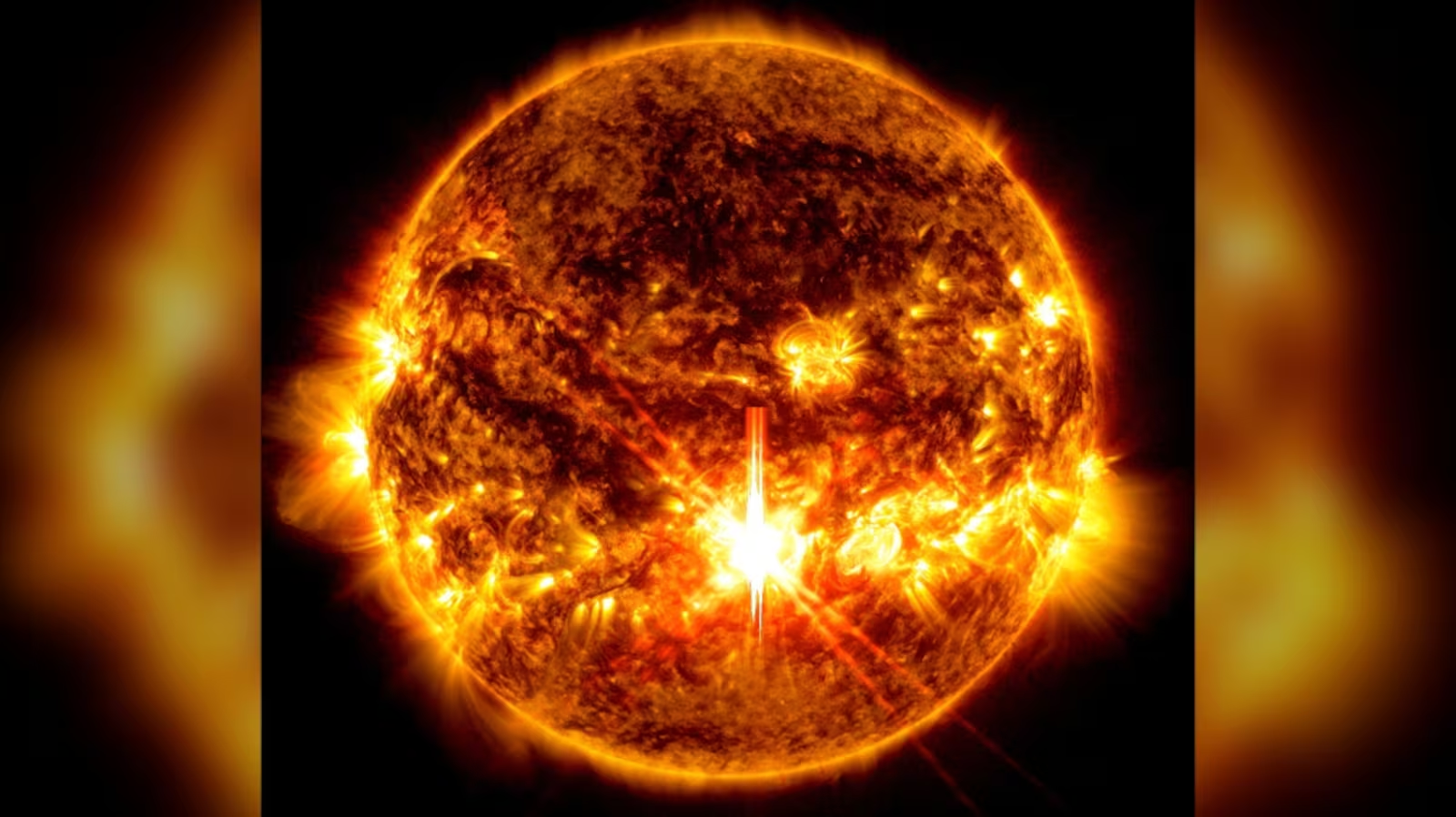
A bright solar flare is seen erupting at the centre of the Sun on Oct. 3, 2024, in an image from NASA’s Solar Dynamics Observatory. NASA/AP
Astronomers announced a major milestone on Wednesday after detecting a massive storm on a star far beyond our solar system. It marks the first time researchers have confirmed such an event happening on a star other than the Sun. The violent blast came from a small red dwarf more than 133 light-years away and carried enough force to strip away the atmosphere of any nearby planets.
On our own Sun, similar events—called coronal mass ejections—can send huge bursts of charged particles into space. When these reach Earth, they sometimes disrupt satellites and trigger brilliant auroras across the sky. A strong storm this week created vivid lights as far south as Tennessee and bright displays over New Zealand.
Seeing these storms on distant stars, however, has long challenged astronomers. Detecting them requires extremely sensitive equipment and careful study over long periods.
How Scientists Found the Stellar Blast
The breakthrough came from an international team using LOFAR, a large network of radio telescopes spread across Europe. The system usually helps researchers study powerful cosmic events such as black holes, which emit steady radio signals over time. While these observations continue, the telescope constantly picks up background signals from stars in the same field of view.
Cyril Tasse, a co-author of the study, explained that researchers later built a processing system to capture this extra information. By 2022, the team decided to review years of archived data to see what they might have overlooked.
They found something remarkable. On May 16, 2016, LOFAR recorded a sudden one-minute explosion coming from a little-known red dwarf star named StKM 1-1262. The team determined that the event was a massive coronal mass ejection.
“It’s the first time we have detected one” on another star, Tasse said. He added that the blast was at least 10,000 times stronger than the largest storms recorded on our Sun.
What This Means for Planet Hunters
The finding could reshape the search for life in other solar systems. Red dwarfs are common throughout the galaxy and often host small, rocky planets similar in size to Earth. Because of this, they are considered key targets in the search for habitable worlds.
But this new discovery raises concerns. Researchers say red dwarfs may behave far more unpredictably than the Sun, producing intense storms that could strip away the atmospheres of nearby planets. Without an atmosphere, a planet loses crucial protection from radiation and cannot maintain stable conditions needed for life.
Study co-author Philippe Zarka said the detection opens “a new era for space weather applied to other star systems.” Understanding how often these storms happen, and how strong they are, will help scientists better judge whether planets around red dwarfs can support life.
Tasse added that the behaviour of these stars makes them “rather inhospitable,” and their violent activity could make it difficult for nearby planets to remain healthy and stable.