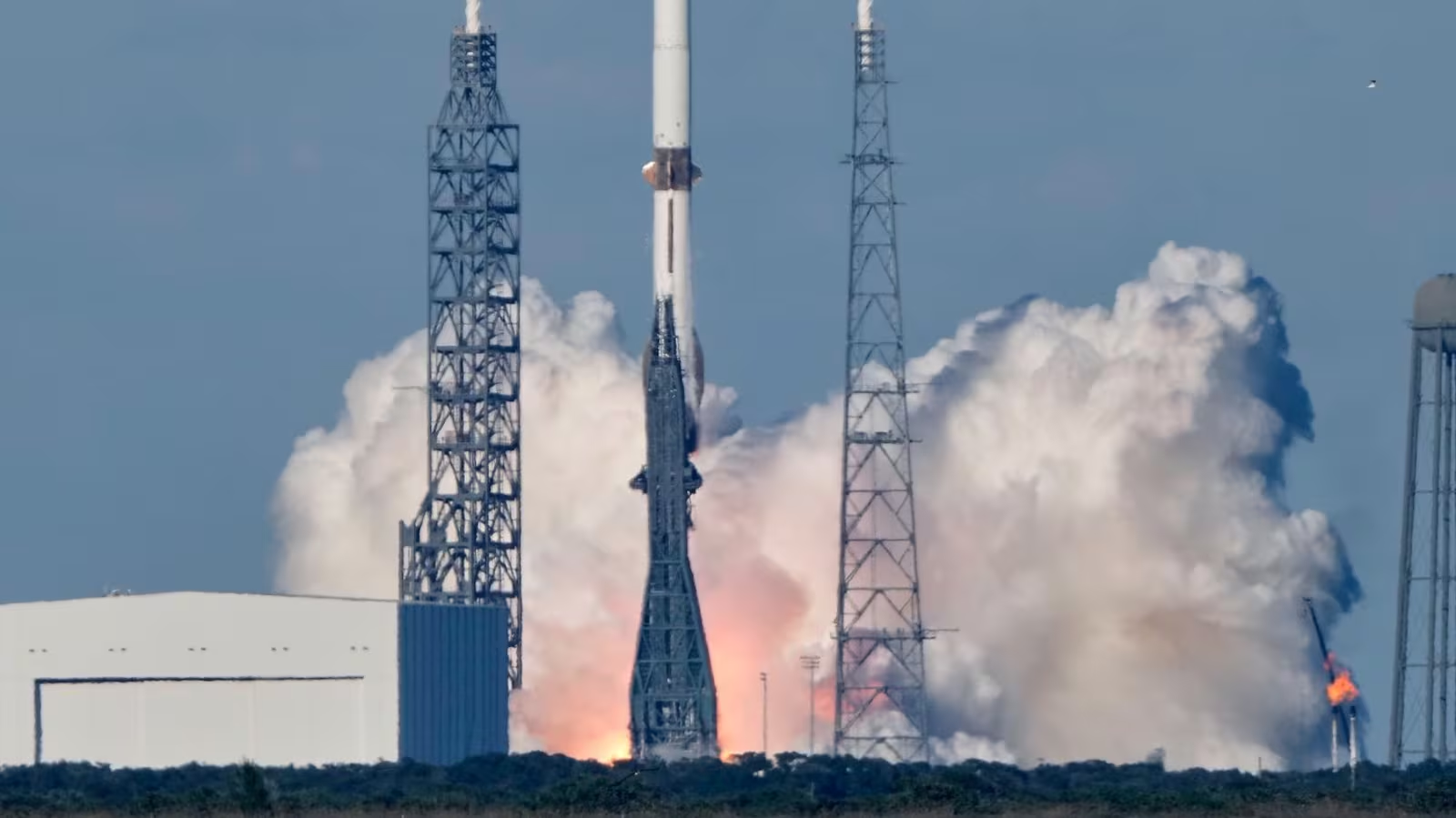
A Blue Origin New Glenn rocket lifted off from Launch Complex 36 at Cape Canaveral Space Force Station in Florida on November 13, 2025. AP Photo
Blue Origin launched its New Glenn rocket on Thursday, sending a pair of NASA spacecraft toward Mars. The afternoon liftoff from Cape Canaveral marked only the rocket’s second mission and delivered a major moment for Jeff Bezos’ space company. NASA and Blue Origin both see New Glenn as the future workhorse for carrying crews and cargo to the moon.
The towering 321-foot rocket rose through clear skies after four days of delays caused by rough weather and strong solar storms. Those storms produced rare auroras that reached as far south as Florida.
A Big Win for Blue Origin
Moments after the booster separated from the upper stage, Blue Origin made history. For the first time, the company recovered the booster intact, landing it upright on a barge 600 kilometres offshore. Employees watching from mission control erupted in cheers as the rocket touched down. Bezos watched the landing live, visibly thrilled.
“Next stop, moon!” workers chanted as the booster stood safely on deck.
The success brings Blue Origin one step closer to routine reuse, a key factor in lowering launch costs.
The rocket’s first test flight in January launched a prototype satellite but failed to recover the booster. Thursday’s mission marked a major improvement.
NASA’s Twin Mars Orbiters
The spacecraft on board — two identical Mars orbiters called Escapade — will spend the next year in a parking orbit near Earth, about 1.5 million kilometres away. Once Earth and Mars line up next fall, the orbiters will swing past Earth for a gravity boost and begin their journey to Mars, arriving in 2027.
Once in orbit around the planet, the pair will study Mars’ upper atmosphere and scattered magnetic fields. Their joint observations should help reveal how solar wind strips away the Martian atmosphere, a process believed to have transformed Mars from a warm, watery world into a dry, cold one. Scientists also hope to learn more about the radiation conditions astronauts will one day face.
“We really, really want to understand the interaction of the solar wind with Mars better than we do now,” said lead scientist Rob Lillis. He noted that Escapade’s two-spacecraft design offers a rare “stereo viewpoint.”
A Budget-Friendly Mission
Escapade is operated by the University of California, Berkeley and cost less than US$80 million. NASA kept costs down by booking one of New Glenn’s first missions. The orbiters were initially meant to launch last year but were delayed because of worries about whether Blue Origin would have New Glenn ready in time.
The Bigger Picture
New Glenn is named after astronaut John Glenn, the first American to orbit Earth. It stands five times taller than the company’s New Shepard rockets, which fly tourists on short hops from Texas. Blue Origin plans to use New Glenn to launch its Blue Moon lunar lander prototype later this year.
The company also holds NASA’s contract for the third crewed moon landing under the Artemis program. SpaceX won the contracts for the first two landings, but NASA recently reopened the first landing contract due to concerns about SpaceX’s Starship schedule.
NASA expects to send astronauts around the moon early next year using its own SLS rocket. The agency aims to put astronauts back on the lunar surface before the decade ends as global competition for the moon increases.