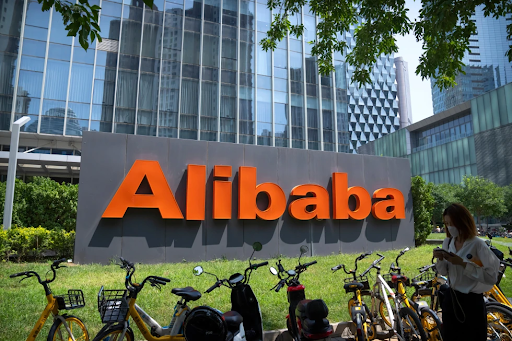
The logo of Chinese technology firm Alibaba is seen at its office in Beijing, Aug. 10, 2021.
Alibaba’s cloud business delivered an impressive performance this quarter, powered by a soaring global demand for artificial intelligence. The Chinese tech giant reported a 34% jump in cloud revenue, marking its strongest surge in recent years. Yet overall growth remained modest, reflecting broader challenges in China’s competitive e-commerce market.
Cloud Revenue Soars Amid Rising AI Adoption
Alibaba said the cloud unit’s revenue growth was fueled by accelerating AI usage across industries. The 34% rise surpassed the 26% growth seen in the previous quarter, highlighting the rapid shift toward AI-driven services.
The company noted that demand for AI continues to intensify. Its confidence in long-term AI expansion remains strong, prompting expectations that it may invest more than its planned 380 billion yuan over the next three years. These funds are earmarked for cloud computing, AI infrastructure, and foundational technologies.
E-Commerce Price War Hits Overall Profit
Despite the cloud business outperforming expectations, Alibaba’s overall revenue rose only 5% year-on-year to 247.8 billion yuan ($35 billion) for the July–September quarter.
Profit fell sharply by 52%, with the company attributing the decline to China’s aggressive price wars in e-commerce and food delivery. Intense competition has forced major platforms to reduce prices, affecting short-term profitability.
Alibaba’s rival JD.com also felt the pressure, reporting a 55% drop in net profit during the same period.
AI Investments Strengthen Alibaba’s Position
CEO Eddie Wu emphasized that Alibaba’s significant investments in AI played a key role in boosting revenue. He reaffirmed the company’s commitment to expanding its AI footprint as demand accelerates worldwide.
The company’s upgraded AI chatbot, Qwen, achieved strong early success. It crossed 10 million downloads in its first week after launch, positioning Alibaba as a serious contender to global giants like OpenAI.
Investor confidence followed. Alibaba’s Hong Kong-listed shares rose 2%, while U.S.-listed shares climbed 2.4% before the New York market opened. The stock is already up more than 90% this year, driven largely by optimism around AI innovation.
Chinese AI Companies Gain Global Momentum
China’s tech sector has gained significant traction in AI following the rise of DeepSeek, a startup that disrupted the global landscape and challenged U.S. dominance.
Recent earnings across Chinese tech giants, however, paint a mixed picture.
- Tencent reported a 15% revenue increase, reflecting strong digital ecosystem performance.
- Baidu, also a major AI competitor, posted a 7% revenue decline, signaling uneven growth across the industry.
These contrasting results highlight the uncertainty surrounding China’s AI race, even as companies ramp up innovation and investment.
Growing Concerns Over an AI Bubble
While AI continues to attract record investment, analysts warn of a potential AI bubble. Rapid funding, inflated valuations, and intensifying competition have sparked debates about the sustainability of current growth.
However, strong earnings from Nvidia—a key player in global AI hardware—helped ease some concerns last week, reassuring investors that AI demand remains solid.
Alibaba’s AI-Driven Future
With cloud services expanding and AI adoption accelerating, Alibaba is doubling down on the sectors it believes will drive its next era of growth.
The company’s aggressive investment strategy, combined with rising demand for AI-powered tools like Qwen, signals a decisive shift toward becoming a global AI leader.
Despite slowing e-commerce profits, Alibaba’s cloud momentum and AI breakthroughs suggest a transformative path ahead—one shaped by innovation, infrastructure, and a rapidly evolving digital ecosystem.