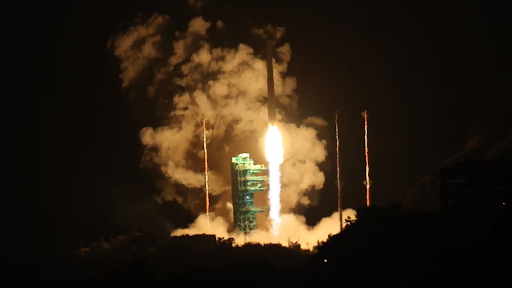
The Nuri rocket launched from the Naro Space Center in Goheung, South Korea, on Thursday, Nov. 27, 2025. AP Photo
South Korea completed a major milestone early Thursday with the launch of its largest satellite to date. The liftoff took place at the country’s island spaceport in Goheung. Officials confirmed that the Nuri rocket, a three-stage launcher developed with homegrown technology, carried the satellite safely into orbit about 600 kilometres above Earth.
This launch marks the fourth flight of the Nuri rocket and is part of a planned series of six missions set to run through 2027.
Satellite Contacts Ground Team
The Korea Aerospace Administration said the main 516-kilogram science satellite contacted a South Korean station in Antarctica roughly 40 minutes after liftoff at 1:55 a.m. The satellite deployed its solar panels and began normal operations.
Twelve smaller microsatellites also travelled aboard the rocket. They will each contact their ground stations according to their communication schedules.
Leaders Applaud the Mission
Kyunghoon Bae, the country’s science minister, praised the launch and said it confirms South Korea’s ability to run its own space missions without outside support. He called the successful flight a “turning point” for the national space industry.
For the first time, a private company, Hanwha Aerospace, assembled the rocket. The company built the launcher under a technology transfer from the national space agency. Bae said the partnership shows the growing role of private industry in South Korea’s space goals.
“Building on today’s success, we will steadfastly pursue the development of next-generation launch vehicles, lunar exploration and deep-space missions,” he said.
What the Satellites Will Study
The newly launched main satellite carries a wide-range airglow camera used to monitor auroras above Earth. It also includes tools to study magnetic fields, plasma and how biological experiments react in space.
The twelve small “cube” satellites came from universities and research groups. They carry equipment to track atmospheric changes, test solar cells, study communication systems and monitor plastic spread through the oceans using infrared cameras.
Nuri’s Track Record
This week’s mission is the first Nuri launch since May 2023, when the rocket successfully placed a smaller satellite into orbit. The rocket made its first attempt in 2021, though that mission failed when it released a dummy payload too early.
South Korea plans two more Nuri launches in 2026 and 2027. These missions aim to strengthen the country’s position among Asian space powers, including China, Japan and India.
A Rocket Built at Home
Nuri uses five 75-ton engines in its first two stages and a smaller engine in its third stage. This third engine releases each payload once the rocket reaches the correct height. The system relies mainly on South Korean engineering, which officials call crucial for long-term independence in space exploration.
Before Nuri, South Korea relied heavily on foreign partners for space launches. Its first successful liftoff came in 2013, when a rocket built partly with Russian technology placed a satellite into orbit. Earlier attempts in 2009 and 2010 failed, including one rocket that exploded shortly after leaving the ground.