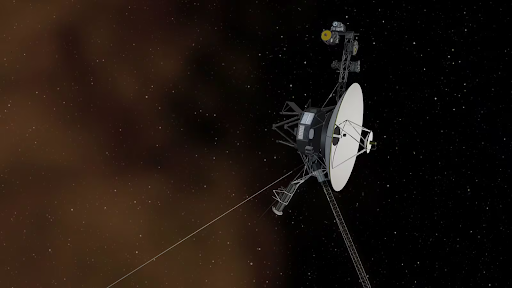
An artist’s illustration shows Voyager 1 moving into interstellar space, the region between stars. CNN
Voyager 1, NASA’s record-setting deep-space probe, will hit a remarkable distance from Earth in November 2026. At that point, it will sit one light-day away — meaning a radio signal travelling at the speed of light will need a full 24 hours to reach it.
The probe, launched in 1977, now travels more than 15.8 billion miles from Earth. Suzy Dodd, the project manager at NASA’s Jet Propulsion Laboratory, explained that one light-day equals about 16 billion miles, or 26 billion kilometres. Once Voyager reaches that distance, messages will move painfully slow.
“If I send a command and say, ‘good morning, Voyager 1,’ at 8 a.m. on a Monday morning, I’m going to get Voyager 1’s response back to me on Wednesday morning at approximately 8 a.m.,” Dodd said.
Exploring Beyond the Sun’s Reach
Voyager 1 and Voyager 2 are the only spacecraft travelling outside the heliosphere — the vast bubble of solar particles and magnetic fields that surrounds our solar system. Both probes still gather data, even though many instruments have been shut down to save power. Their observations help researchers understand the environment beyond the sun’s influence and plan future deep-space missions.
The Voyagers face constant challenges due to their extreme distance. Yet the team remains determined to keep them operating through their 50th anniversary in 2027.
How Engineers Stay Connected
Voyager 1 continues on the same path and speed — about 38,000 miles per hour — that it followed after passing Saturn in 1980. With no course changes since its last major planetary encounter, the probe simply coasts outward.
Engineers calculate how long signals take by tracking its distance and trajectory. Voyager 2, moving in a different arc after its 1989 Neptune flyby, won’t reach the one-light-day point until 2035 — well after its expected operating life.
Keeping in touch isn’t easy. The probes send data at only 160 bits per second, a rate slower than early dial-up internet. Dodd said the weakening signal forces NASA to use multiple antennas just to collect the incoming data. When problems arise, the team often waits days before responses come back.
Fortunately, both spacecraft can protect themselves. Each carries systems that place it in a “safe state” if something goes wrong, allowing time for help to arrive from Earth — even if that help takes days.
Stretching Power for Science
Dodd’s team has made many difficult choices to conserve energy. They shut down heaters and instruments to keep the probes functioning. They also monitor the temperature of key parts, including propellant lines. If those lines freeze and the spacecraft can’t point its antenna at Earth, communications could end permanently.
Scientists hope to keep certain instruments alive until 2027, such as the magnetometers and plasma detectors. These help track the heliopause — the boundary between solar influence and interstellar space. Dodd compares it to wading from a beach into the ocean, watching how ripples change farther from shore.
“What’s important is operating with these science instruments as long as possible to make that map of what changes as you get away from the sun,” she said.
Looking Ahead
Dodd believes at least one Voyager could last another two to five years. The mission now relies on a team that spans generations — from retirees in their 80s to young engineers whose parents weren’t alive when the probes launched.
“I love these spacecraft. They’re ambassadors for us here on Earth,” Dodd said.