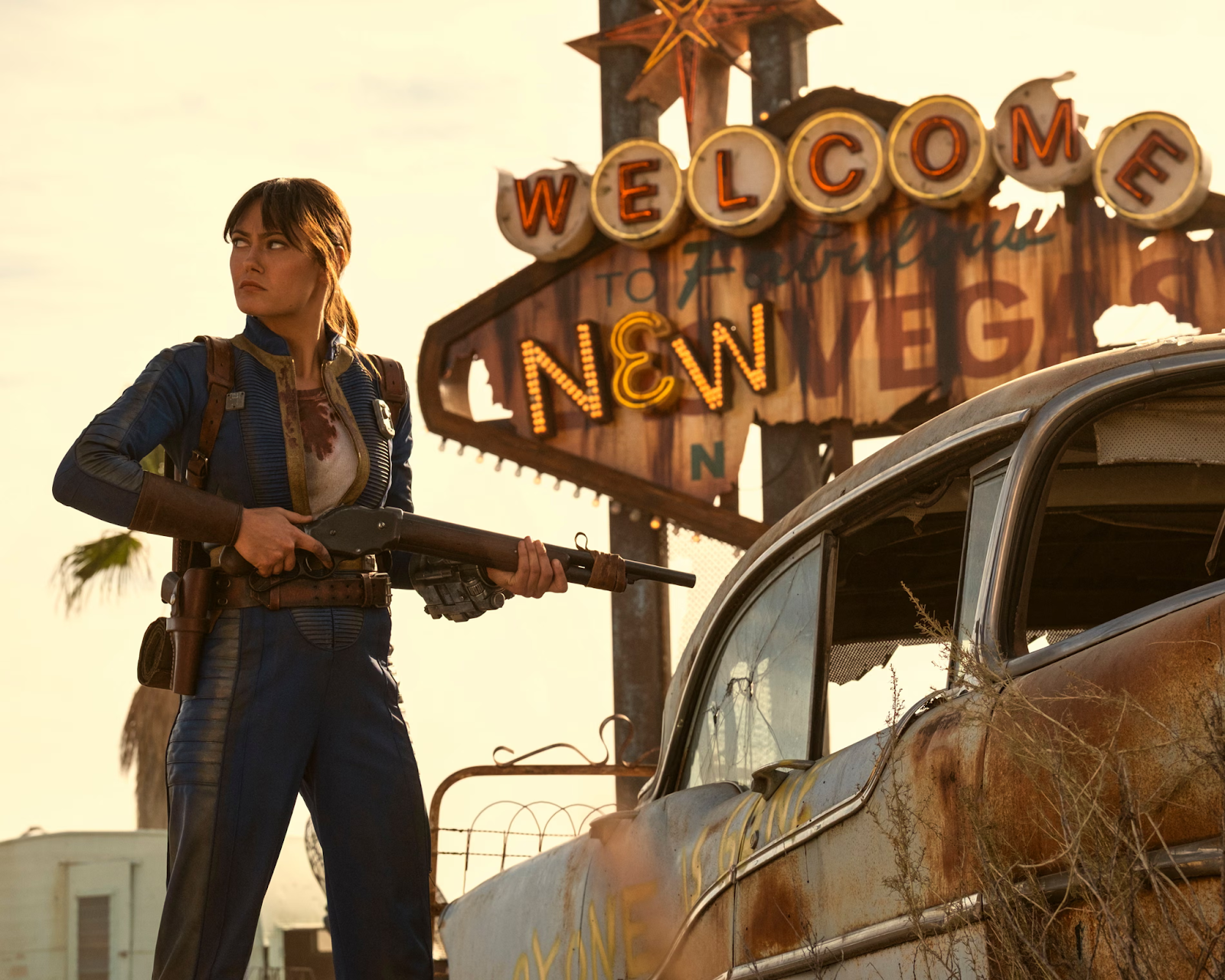
Okey-dokey … Ella Purnell as Lucy in Fallout, season two.Prime Video
Two hundred years after nuclear devastation, the world of Fallout should feel relentlessly bleak. Instead, Prime Video’s postapocalyptic series remains one of television’s sharpest and funniest genre shows. Season two doubles down on that winning formula, blending brutal violence with sly comedy and an expanded cast of scene-stealing characters.
A Wasteland Filled With Jokes
Set in a scorched version of California, Fallout depicts a future of sand dunes, mutant creatures, outlaw gangs, and constant danger. Food is scarce. Morality is flexible. Death lurks everywhere.
Yet the show rarely wallows in despair. Its wicked humour continues to set it apart from grimmer apocalypse dramas like The Walking Dead or The Last of Us. Even its darkest moments are punctuated by satire and absurdity.
Season one made its tone clear early. An unsettling scene involving discarded puppies established both the villains and the show’s gleeful cruelty. That comic edge carried through, helping Fallout feel anarchic rather than oppressive.
Characters Who Ground The Chaos
The comedy works because the characters play it straight. Ella Purnell’s Lucy remains the emotional anchor. Raised in a sheltered underground vault, she once faced the surface world with wide-eyed optimism and relentless politeness.
That innocence has evolved. Lucy is tougher now, quicker with a gun, and slightly less shocked by the horrors around her. Still, she clings to empathy, even when it feels wildly out of place.
Her uneasy partnership with the Ghoul remains the show’s beating heart. Walton Goggins continues to impress as the scarred, sardonic gunslinger, his CGI-altered face and cowboy swagger masking deep emotional scars.
If the suit fits … Aaron Moten, right, as Maximus in Fallout season two. Credit: Theguardian via Prime Video
Digging Deeper Into The Past
Season two leans further into the Ghoul’s pre-apocalypse life as Cooper Howard, a movie star navigating paranoia and corporate power in a twisted version of 1950s America.
These flashbacks are visually stunning, filled with retro-futurist designs, glossy cars, and robotic conveniences. They also deepen the mystery surrounding the original nuclear catastrophe.
Cooper’s strained marriage to Barb, a Vault-Tec executive, gives the storyline emotional weight. It also hints at how corporate ambition may have helped destroy the world.
Familiar Faces Return
The narrative continues to jump between storylines, trusting viewers to keep pace. Lucy’s former vault community resurfaces often, especially her brother Norm, now locked in a bizarre psychological battle with a brain preserved in a jar.
Maximus also returns, drifting uneasily back into his militaristic brotherhood. His quiet dissatisfaction contrasts sharply with his earlier taste of freedom alongside Lucy.
The storytelling remains dense but confident, juggling conspiracies, slapstick violence, and character growth without losing momentum.
Walton Goggins as Cooper Howard in Fallout season two.
Big Guest Stars, Bigger Personalities
Season two adds several attention-grabbing guest performances. Kumail Nanjiani clearly enjoys playing a swaggering heavy, while Macaulay Culkin brings unsettling energy in later episodes.
The standout newcomer, however, is Justin Theroux. He plays Robert House, a reclusive tech magnate with Howard Hughes tendencies and a grand vision for humanity’s future.
Theroux’s performance is deliciously unhinged. His precise diction, theatrical intensity, and barely contained zeal make him instantly memorable, even with limited screen time.
More Games, More Madness
The new season draws more directly from the Fallout games, particularly Fallout: New Vegas. Fans will spot familiar themes and references, but newcomers won’t feel lost.
What matters more is the show’s rhythm. For every shadowy conspiracy, there are multiple grotesque deaths, visual gags, and another perfectly delivered “okey-dokey” from Lucy.
Weekly Release, Same Wild Appeal
Unlike season one’s binge-friendly drop, episodes now release weekly. The change may encourage theory-sharing among hardcore fans.
Still, Fallout works best as visceral entertainment. It thrives on excess, irreverence, and surprise.
Season two confirms the show’s greatest trick. In a world built on annihilation, Fallout somehow makes the end of civilisation feel wickedly fun.