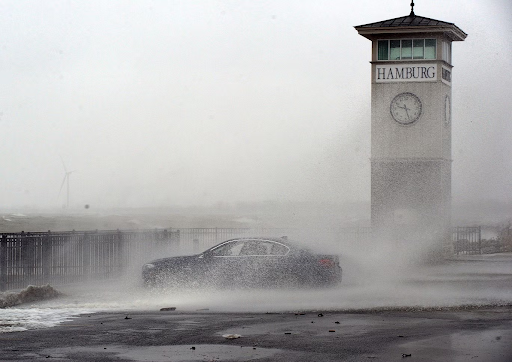
Strong waves slammed into the pier in Hamburg, New York, on Monday as powerful winds battered the lakeshore. Getty Images
Powerful winds swept across Lake Erie this week, pushing water from one end of the lake to the other and causing flooding in parts of Buffalo. Weather experts said the event resulted from a rare but known natural effect called a seiche.
On Monday, strong southwest winds blew steadily toward Buffalo at speeds between 35 and 45 miles per hour. Gusts climbed as high as 75 miles per hour, creating dangerous conditions along the shoreline.
Lake Drains in the West, Rises in the East
The powerful winds forced lake water eastward, raising water levels quickly near Buffalo while leaving parts of the western shoreline exposed. By 12:30 p.m., water levels in Buffalo had climbed more than six feet compared to early morning readings.
At the opposite end of the lake, near Toledo, water levels dropped by about 13 feet. The sudden shift revealed lakebed areas that normally stay underwater.
Lake Erie stretches roughly 225 miles and covers nearly 10,000 square miles, touching several U.S. states. This size allows strong winds to move water dramatically from one side to the other.
Experts Explain the Rare Weather Effect
Meteorologists explained that wind direction and air pressure worked together to create the event.
“It’s like sloshing the water in your bathtub,” said Scott Sabol, a meteorologist with Fox8.
“The water will go from the west of the lake to the east part of the lake and will drastically change the height of the lake over a short period of time.
“The levels then return to normal after the winds die down.”
Photos and videos from shoreline towns showed waves crashing into piers and water spilling over roads and walkways.
Storm Adds to Harsh Winter Conditions
The wind event struck as much of the Northeast dealt with heavy snow and freezing temperatures. Ice and snow covered roads across New York and New England, prompting officials to urge drivers to slow down and stay alert.
The National Weather Service issued high wind warnings for Monday and Tuesday. Officials warned that strong gusts could knock down trees and power lines. Lakeshore flood warnings also remained in effect.
Meteorologist Tom Niziol shared updates showing waves pushing water onto land as people struggled to walk against the wind.
“There is nearly an 8-foot difference now between the water level at Buffalo and Toledo, along the 225-mile stretch of Lake Erie,” he wrote.
Residents Describe Severe Damage
Niziol also described the storm’s impact on the Buffalo area.
“In all my years living up here in Buffalo, I don’t think I’ve ever seen it this bad along the Lakeshore,” he said.
“We’ve had three hours of 80+ mph gusts here and with the temperature dropping, very heavy freezing spray is accumulating on all of the trees. Lots of damage.”
Crews continued to monitor conditions as winds slowly weakened and water levels began to stabilize.