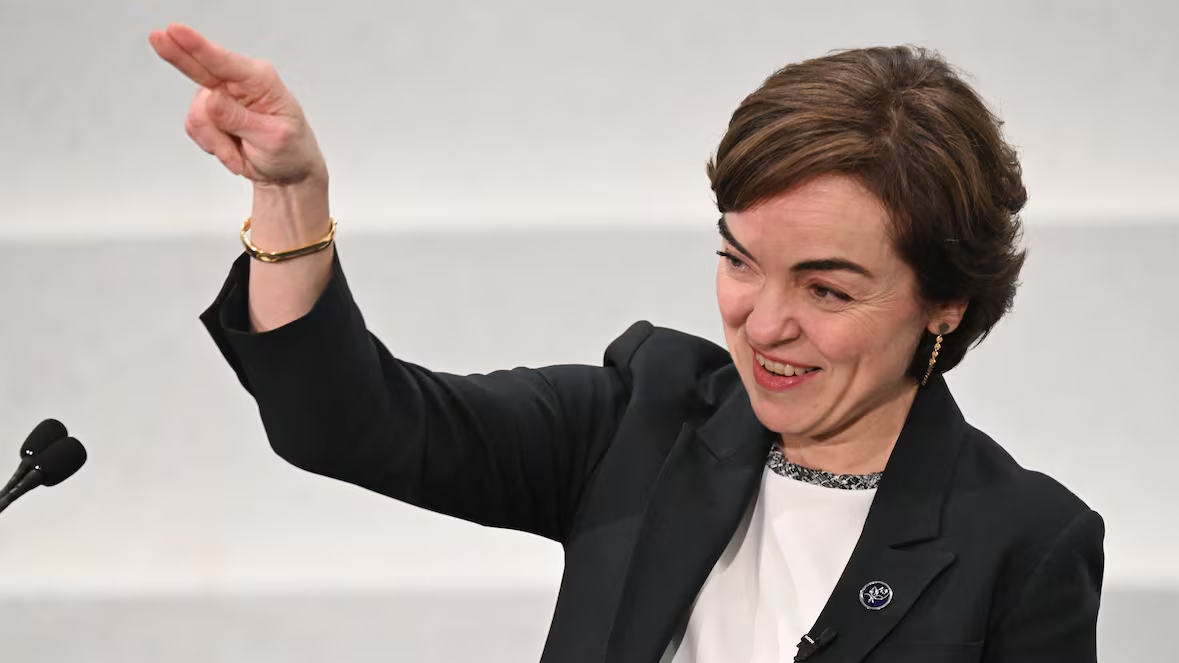
Denmark’s foreign minister Lars Løkke Rasmussen called on the United States to work respectfully with Denmark and Greenland when discussing the island’s future. AP
Denmark has warned of a serious disagreement with the United States after high-level talks in Washington focused on the future of Greenland.
Denmark’s foreign minister, Lars Lokke Rasmussen, said discussions at the White House revealed a clear divide between the two countries. He met with US Vice-President JD Vance and Secretary of State Marco Rubio on Wednesday.
Rasmussen described the meeting as “frank but constructive” but said US President Donald Trump continued to press for control of Greenland, a stance Denmark firmly rejects.
“Totally unacceptable,” says Denmark
Rasmussen said the US position crossed a line for Denmark.
“We made it very, very clear that this is not in the interest of [Denmark],” he said.
He added that President Trump was insisting on “conquering” Greenland, calling the idea “totally unacceptable.” Trump later repeated his view that the United States needs Greenland for security reasons, comments that have unsettled European allies and increased tension within NATO.
No breakthrough, but talks to continue
The hour-long meeting between officials from the United States, Denmark, and Greenland did not deliver a major agreement. However, all sides agreed to create a high-level working group to continue discussions about the autonomous Danish territory.
Rasmussen said Denmark had clear “red lines” that the US could not cross. He said the working group would meet in the coming weeks to try to find common ground. He also confirmed that Denmark and Greenland remain open to allowing the US to expand its military presence on the island.
“It’s productive to start discussions at a high level,” he said.
Security concerns and disputed claims
Rasmussen acknowledged there was an “element of truth” in Trump’s argument that security in the Arctic needs strengthening to address Russian and Chinese interests. However, he rejected Trump’s claims about Russian and Chinese warships operating near Greenland, calling those statements “not true.”
Greenland’s strategic location between North America and the Arctic makes it important for early missile warning systems and monitoring ship traffic. The US already operates the Pituffik military base in northwest Greenland, where more than 100 American personnel remain stationed.
Under existing agreements with Denmark, the US can deploy additional troops to Greenland if needed.
Greenland sets its limits
After the talks, Greenland’s foreign affairs minister, Vivian Motzfeldt, said Greenland welcomed closer cooperation with the United States but opposed any takeover.
“We have shown where our limits are,” Motzfeldt said.
Vice-President Vance and Secretary Rubio did not comment publicly after the meeting.
Europe rallies behind Greenland
European allies moved quickly to show support for Greenland. Sweden pledged to send armed forces to the island at Denmark’s request. Germany announced plans to send a reconnaissance team to assess possible military support.
The United Kingdom also agreed to send one military officer as part of the same effort. France said it would open a consulate in Greenland next month and confirmed that French military personnel were already heading to the island.
Denmark said any military expansion would take place “in close co-operation with allies,” adding that “geopolitical tensions have spread to the Arctic.”
Growing pressure and public opposition
Trump has repeatedly said Greenland is vital to US national security and to his planned missile defence system, Golden Dome. He has not ruled out the use of force, though he also mentioned other options such as purchasing the territory.
Public opinion polls show strong resistance. Most Greenland residents oppose US control, and surveys indicate most Americans also reject the idea.