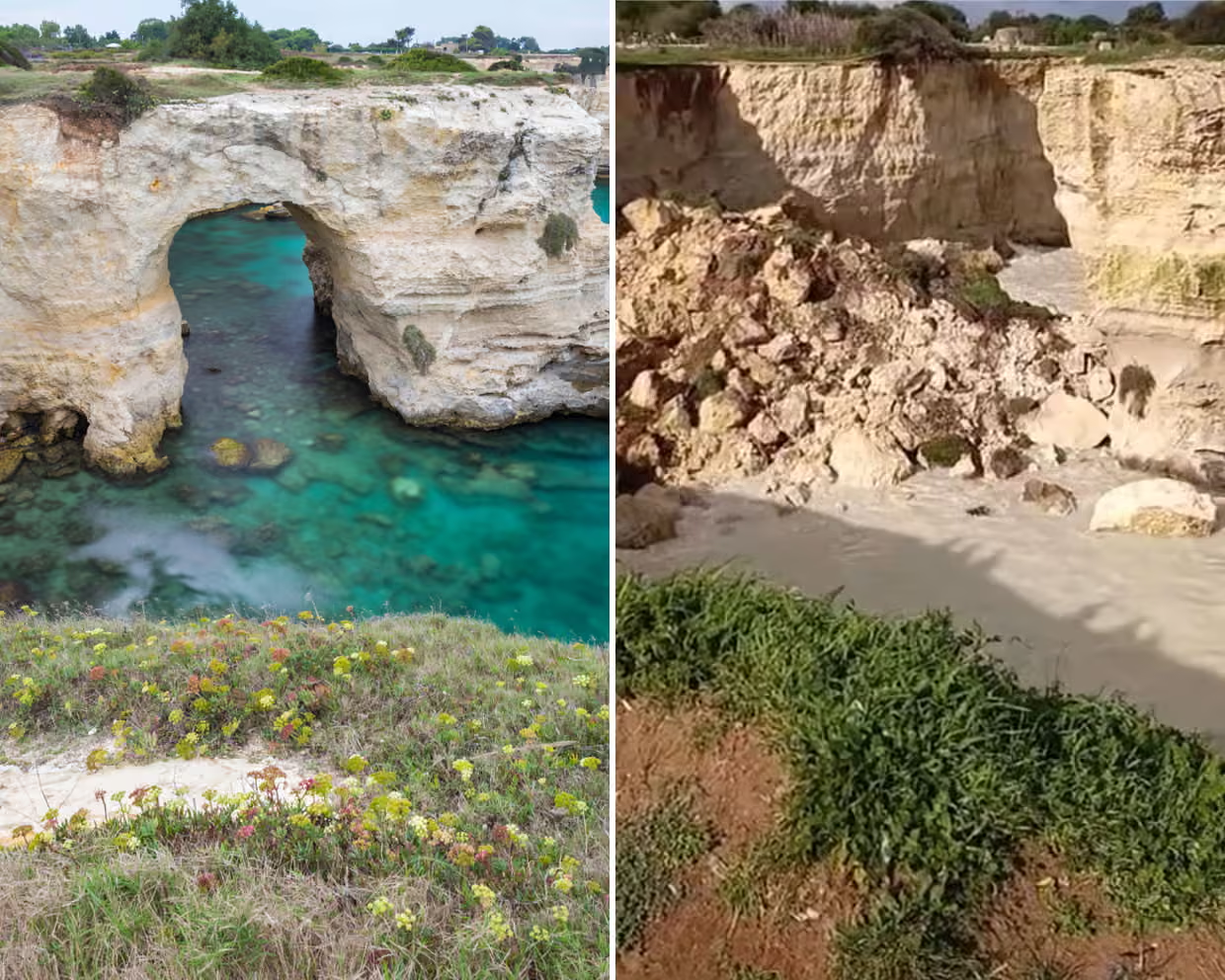
The natural rock arch at Sant’Andrea in Melendugno is shown before its collapse and after it fell into the sea. The images capture the dramatic change to the coastline following the recent storm damage. The Guardian
One of southern Italy’s most cherished natural landmarks has disappeared. The famous Lovers’ Arch at Sant’Andrea in Melendugno, Puglia, collapsed into the Adriatic Sea on Valentine’s Day after days of powerful storms and heavy rain.
The rocky formation, shaped over centuries by wind and water, stood as one of the best-known sights along the Adriatic coastline. Visitors often chose the arch as the setting for marriage proposals, holiday photos and postcards. For many, it symbolized romance and the beauty of the Salento region, one of Italy’s most popular tourist destinations.
Storms Weakened the Structure
Local officials said strong winds, rough seas and intense rainfall gradually weakened the rock over several days. By Saturday, the natural structure could no longer withstand the pressure and gave way.
“It is a devastating blow to the heart,” said Melendugno’s mayor, Maurizio Cisternino. “One of the most famous tourist features of our coastline and of the whole of Italy has disappeared.”
Authorities described the collapse as the most serious damage caused by coastal erosion in the Salento area in recent years. Many residents said the loss feels deeply personal.
“It’s like a funeral,” said Melendugno’s tourism councillor, Francesco Stella.
A Changing Coastline
Experts point to a broader pattern of extreme weather across the Mediterranean. Powerful Mediterranean cyclones, often called medicanes, have struck the region more frequently in recent years. Cyclone Harry hit southern Italy in January, bringing torrential rain and fierce winds.
Professor Christian Mulder, an expert in ecology and climate studies at the University of Catania in Sicily, warned about the growing impact of warmer sea temperatures. “With the Mediterranean [experiencing] among its hottest years on record in 2025, warmer seas are supercharging the atmosphere and fuelling extreme events,” he said.
Storm systems like these bring winds that can exceed 60 miles per hour and waves that rise as high as 15 metres. Such conditions place enormous stress on coastal landscapes, ports and seaside towns.
Damage Beyond Puglia
The collapse of Lovers’ Arch forms part of a wider pattern of destruction across southern Italy. On January 25, heavy rainfall linked to Cyclone Harry triggered a major landslide in Niscemi, Sicily. A hillside gave way, carving out a four-kilometre gap. Roads fell apart, vehicles sank into the ground and entire sections of the town slipped into the valley below.
Communities across the region now face difficult questions about how to protect their coastlines and infrastructure from future storms.
Mayor Cisternino acknowledged the challenge ahead. “Nature has been overturned: what existed 30 years ago no longer exists. We must find the resources for an organic intervention,” he said.
A Symbol Lost
For tourists and locals alike, Lovers’ Arch represented more than rock and stone. It stood as a symbol of love and natural beauty along the Adriatic shore. Its sudden collapse on a day devoted to romance has left many reflecting on the power of nature and the changing climate.
While officials assess the damage and consider next steps, the sea now flows freely where the arch once stood.