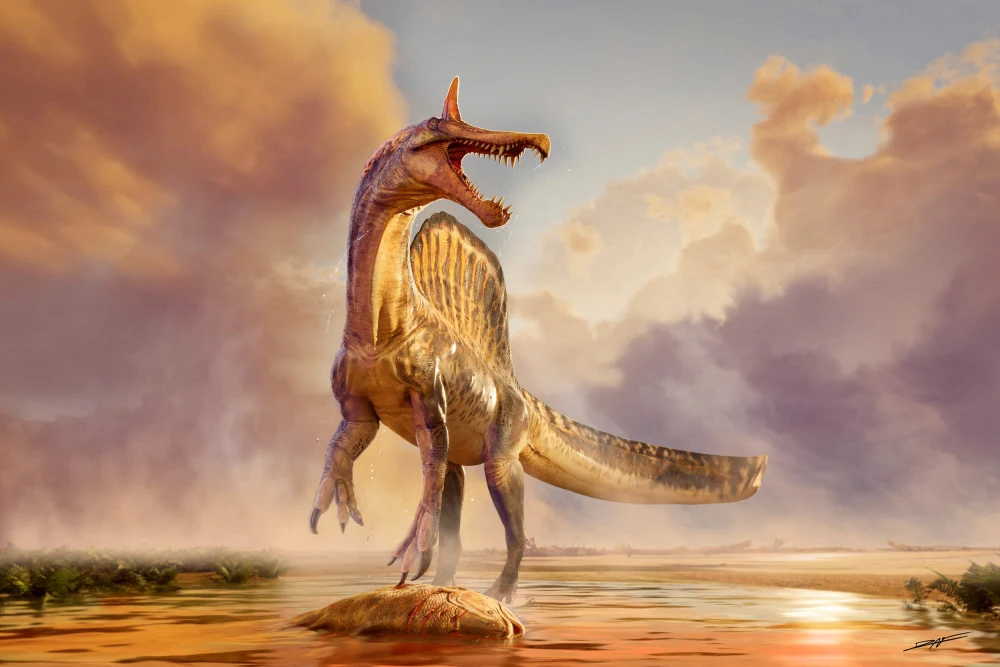
An artist’s rendering shows what Spinosaurus mirabilis may have looked like around 95 million years ago in the region that is now the Sahara Desert in Niger. Reuters
Scientists working in a remote area of the Sahara Desert in Niger have discovered fossils of a new species of Spinosaurus, one of the largest meat-eating dinosaurs ever known. The massive predator measured about 40 feet long and weighed between five and seven tonnes.
Researchers say the dinosaur lived roughly 95 million years ago during the Cretaceous Period. It hunted large fish in rivers and wetlands that once covered parts of what is now desert. One scientist described it as a “hell heron” because of the way it likely waded into shallow water to catch prey, similar to modern birds.
A striking and unusual predator
The newly identified species carries the name Spinosaurus mirabilis. The word “mirabilis” means astonishing, a nod to its dramatic head crest. Spinosaurus means “spine lizard,” referring to the tall spines that formed a sail-like structure along its back.
This dinosaur had a long, crocodile-shaped snout and rows of sharp, cone-shaped teeth designed to grip slippery fish. Its upper and lower teeth locked neatly together during a bite, creating what researchers described as a natural “fish trap.”
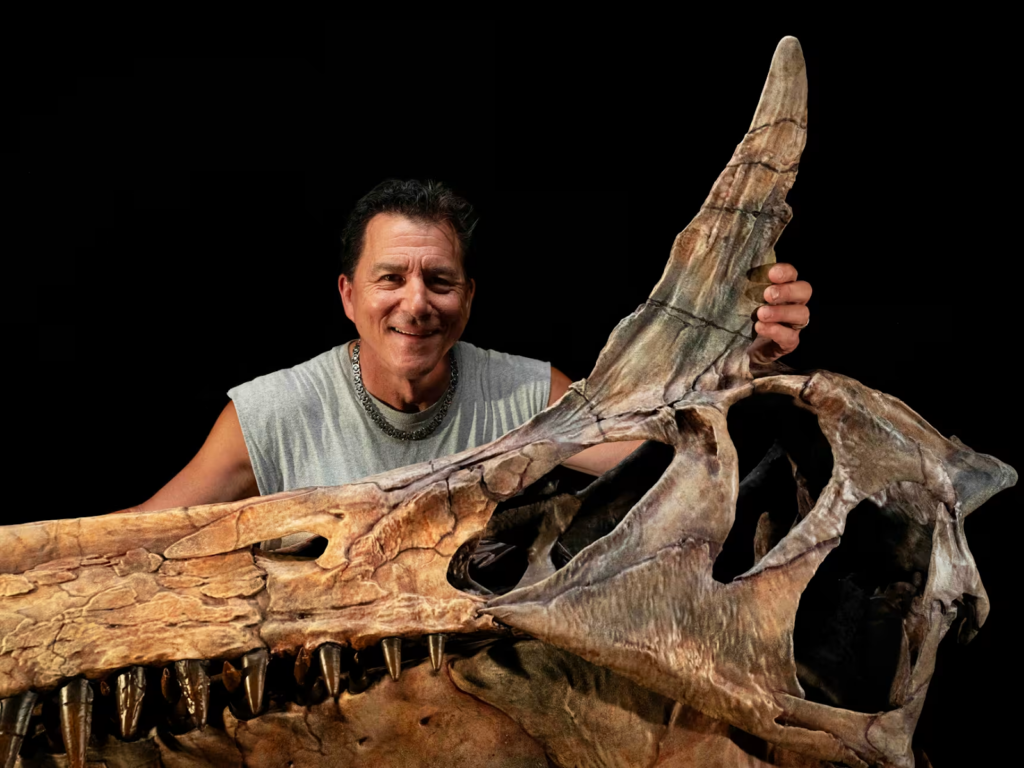
Paleontologist Paul Sereno stands inside his fossil laboratory at the University of Chicago, holding a reconstructed skull of the dinosaur Spinosaurus mirabilis. Reuters
“Their large conical teeth without serrations that interdigitate form a ‘fish trap’ that is very good at piercing and trapping slippery fish in the jaws, preventing them from sliding,” said paleontologist Daniel Vidal.
The species also featured a tall, curved crest on its skull, about 20 inches high. The bony crest resembled a curved sword and likely stood out in the landscape.
“It’s about love and life — attracting a mate, defending your hot feeding shallows,” said paleontologist Paul Sereno. “What else could be more important?”
Only the second known Spinosaurus species
Spinosaurus mirabilis marks only the second known species in its genus. The first, Spinosaurus aegyptiacus, was identified in 1915 based on fossils found in Egypt. Both species lived at roughly the same time and shared similar body features, including the large sail on their backs.
However, the new species had a larger crest, a longer snout, and slightly different limb proportions. Scientists believe these features may have helped it adapt to its specific environment.
Inland discovery challenges old theory
Earlier Spinosaurus fossils came from areas close to ancient coastlines. That led some experts to suggest the dinosaur may have been fully aquatic. However, the new fossils were found hundreds of kilometres inland.
The site, called Jenguebi, lies deep in the Sahara and features sandstone outcrops surrounded by dunes. Researchers travelled for nearly three days across desert terrain to reach the area in 2022. They often struggled with soft sand before finally uncovering skull fragments and other bones from at least three individuals.
The inland location and anatomy of Spinosaurus mirabilis suggest it hunted in shallow rivers rather than swimming in open ocean waters.
Sereno called the discovery “the coup de grâce for the aquatic hypothesis.”
The find places Spinosaurus back in the spotlight among giant meat-eating dinosaurs such as Tyrannosaurus. After decades of living in the shadow of T. rex, this “hell heron” now claims its own place in prehistoric history.
“It’s a dino-happening,” Sereno said.